October 15, 2026
Spiral binding cost depends on whether you need binding alone or a complete printed book, plus the page count, paper, covers, and quantity you order. For a useful 2026 estimate, request an itemized quote for your exact specifications and confirm whether printing, delivery, taxes, and file preparation are included.
The useful figure is the total for your finished project, not an isolated binding charge. A binding-only request covers a different job from printing and binding a complete workbook. Establish that distinction before comparing estimates.
Use the breakdown below to check what each printer has included. Before requesting your 2026 quote, review how to set up a spiral-bound book for printing so the document matches the binding you intend to order.
| Quote component | What to specify | What to confirm |
|---|---|---|
| Interior printing | Finished page count, color or black-and-white, printed sides | Whether printing is included |
| Paper | Interior stock and finished size | Whether every estimate uses the same stock |
| Covers | Cover stock and printed sides | Whether front and back covers are included |
| Binding | Plastic coil or another explicitly named method | Whether punching and assembly are included |
| Quantity | Number of finished books | Whether the total covers the entire order |
| Delivery and taxes | Destination and delivery requirements | Whether these appear in the final total |
| File preparation | Files supplied and any requested corrections | Whether preparation work is included or separate |
A quote is comparable only when its scope matches the other quote. If the paper, page count, or cover specification changes, ask for a revised estimate rather than treating the difference as a binding saving.
Spiral-bound books serve a practical purpose: they stay open while you write, follow instructions, or refer to a page. That matters for workbooks, teaching materials, recipes, and training manuals. Binding should support that use, not just satisfy a purchasing checklist.
For your 2026 project, decide how readers will handle the book before choosing its construction. A manual used beside equipment has different needs from a book intended for spine-out shelving. Compare formats by function before comparing their totals.
A binding-only job starts with pages that have already been printed. Ask whether the printer accepts customer-supplied pages and what condition, size, and order those pages must be in. Do not assume a printing company offers standalone binding simply because it produces bound books.
Confirm who handles trimming, page order, covers, punching, and assembly. Those are separate tasks even when they appear together on an estimate. A stack of loose pages is not necessarily ready to go straight into a binding machine.
Best for: documents you have already printed, provided the binder accepts them. The advantage is keeping usable printed pages; the limitation is that their existing margins and paper choices restrict the finished result.
Check the binding edge before you proceed. Text that sits too close to the edge can conflict with the punched holes, and binding cannot repair that layout problem.
A complete printing-and-binding request starts with your digital files and describes the finished document. Specify the interior, covers, binding, quantity, and delivery destination together. That gives you a complete job to compare rather than a collection of disconnected charges.
Include intentional blank pages in the file and explain how you want them handled. A blank writing page still occupies a physical place in the book. Leaving it out of the specification creates uncertainty about both pagination and thickness.
Best for: new workbooks, manuals, planners, and other projects starting from digital files. The advantage is coordinating printing and finishing together; the limitation is that paper, color, and cover decisions all affect the finished-book estimate.
Keep your 2026 specification in a single document. When you change a detail, update that document before requesting another estimate so every printer receives the same instructions.
These specifications define the amount and type of work in a spiral-bound printing order. Compare them explicitly rather than assuming that documents with similar titles are equivalent.
Delivery, taxes, and any requested file work also belong in your purchasing decision. Ask about them separately if they are not clear in the estimate.
Plastic coil and Wire-O are different binding methods, even though both use holes along the binding edge. Plastic coil uses a continuous spiral threaded through the holes; Wire-O uses paired metal loops. Name the method in your request rather than relying on the word spiral.
Plastic coil can let pages fold back through 360 degrees. That makes it useful when you need to work with a book in a small space, but the exposed coil does not provide a printable spine.
| Binding option | Best for | Main advantage | Main limitation |
|---|---|---|---|
| Plastic coil | Workbooks, planners, hands-on manuals | Lies flat and folds back on itself | No printable spine; holes require clear space |
| Wire-O | Presentation books, calendars, reference documents | Lies flat with paired metal loops | Metal loops can deform if crushed |
| Perfect binding | Books intended for conventional shelving | Creates a continuous spine | Does not naturally lie flat like coil |
| Saddle stitch | Thin programs and booklets | Uses folded sheets with staples at the fold | Folded construction constrains pagination and thickness |
Choose plastic coil for fold-back use, not because you assume it always has the lowest total. Choose another format when its construction better suits the reader. The appropriate comparison holds the interior content and intended use constant.
Use this sequence for a 2026 order. Complete the specification before asking printers to estimate the job, then change only the variables you genuinely want to compare.
A complete request gives you a clear basis for a decision. If a printer suggests a substitute, ask for that alternative as a separately identified version rather than allowing the original specification to disappear.
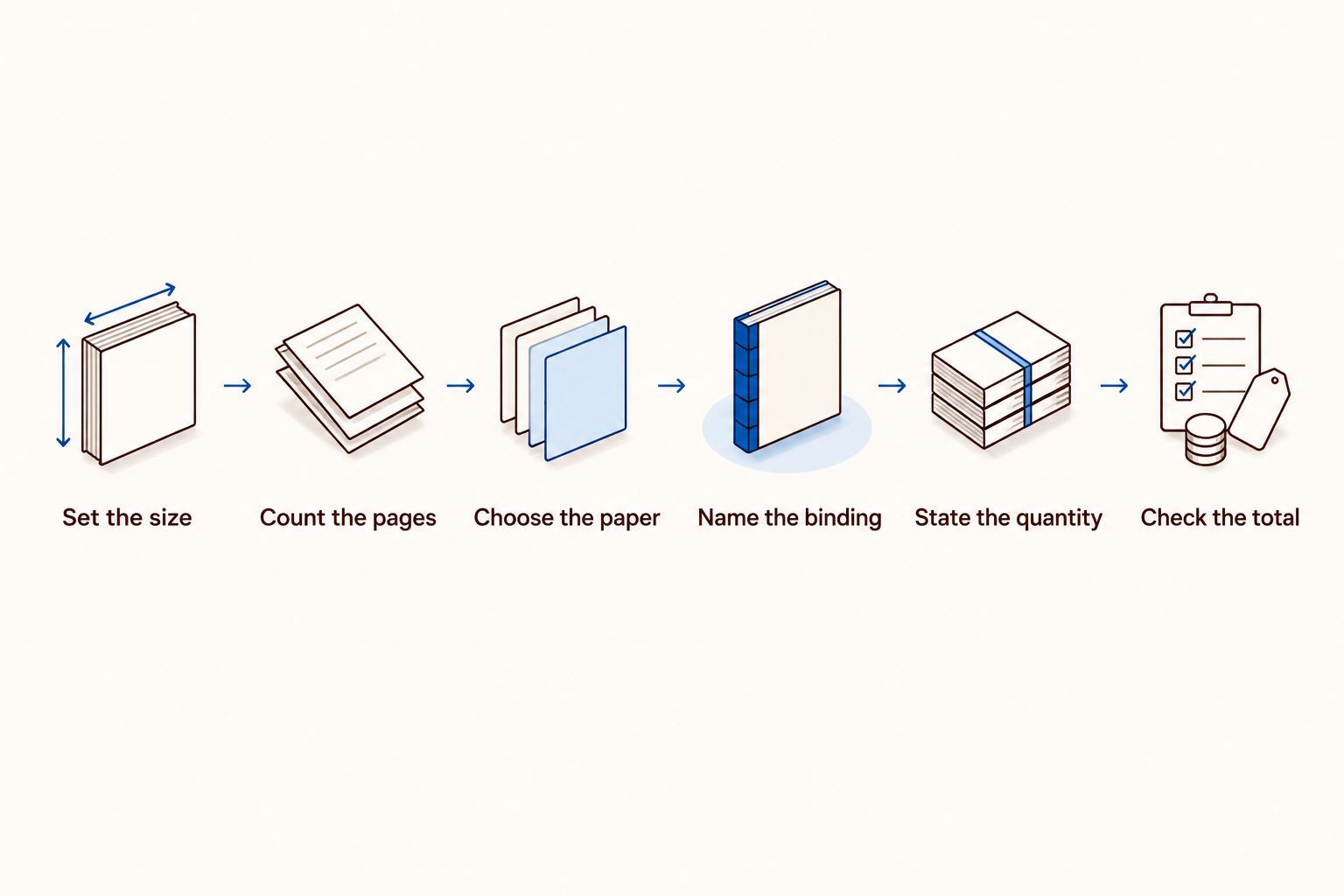
One sheet printed on both sides has 2 pages. Pages describe the faces of the paper; sheets describe the physical pieces. Confusing those terms gives the printer a different job from the one you intended.
Describe the interior by its final PDF page count and state whether it prints single-sided or double-sided. Identify the front and back covers separately. Ask how the printer's order form counts covers instead of assuming every form uses the same convention.
Saddle-stitched booklets use folded sheets that create 4 pages per sheet. Spiral binding uses individual punched leaves, so you should not add blank pages solely to follow a saddle-stitch pagination rule. Follow the chosen printer's file requirements for the actual job.
Spiral binding is not automatically cheaper than perfect binding. The complete specifications and quantity determine the comparison, and the formats solve different problems. Request matched estimates rather than relying on a general ranking.
Plastic coil is useful when the book needs to stay open during a task. Perfect binding suits a conventional book format with a continuous spine. Neither advantage makes the other format wrong; it makes reader use the deciding factor.
Keep the format that performs the job, then adjust optional specifications. A workbook that will not stay open is a poor substitute for a usable workbook, regardless of how attractive its estimate looks.
Start by separating requirements from preferences. Keep the features readers need, such as writable pages and adequate binding clearance, and request alternatives for choices that do not affect the book's purpose.
Evaluate changes individually. If you alter the size, paper, color, and quantity together, you lose a clear view of what each decision does to the estimate.
Publishing Xpress is best for self-publishers and organizations seeking short-run digital printing with plastic coil binding. Its stated options also include Wire-O, perfect binding, and saddle stitch, with black-and-white or color printing and no large minimum order requirements.
The useful next step is to compare your finished-book specification with the options offered by Publishing Xpress. Its plastic coil printing option suits lay-flat projects, but coil's exposed edge and lack of a printable spine remain limitations. Choose it for how the book works, not as a substitute for every other binding.
How much does spiral binding cost for my workbook?
Spiral binding requires a project-specific quote based on the work included, page count, paper, covers, and quantity. Confirm whether the estimate covers binding alone or the complete printed workbook.
Does a spiral-binding quote include printing?
A spiral-binding quote includes printing only when the estimate explicitly lists it. Ask for the interior, covers, binding, and any separate charges to be identified.
Can I get pages I already printed spiral bound?
You need a binder that accepts customer-supplied pages. Confirm that service before bringing or sending pages, and check the required size, page order, and binding-edge clearance.
What’s the difference between plastic coil and Wire-O?
Plastic coil uses a continuous spiral, while Wire-O uses paired metal loops. Both provide lay-flat use, but they are different constructions and should be named separately in a quote request.
How many pages are on a double-sided sheet?
A double-sided sheet has 2 pages, one on each face. State the interior PDF page count and identify covers separately when requesting an estimate.
Does Publishing Xpress offer spiral-bound printing?
Publishing Xpress offers plastic coil binding as part of its short-run digital printing services. Specify plastic coil when requesting the project so the binding method is clear.
Can a spiral-bound book have writing pages?
A spiral-bound book can include writing pages. Choose paper suited to your intended writing tools and keep exercise content clear of the punched binding edge.
Test the binding edge before approving the book. Print a sample interior page at its finished size and inspect the space beside exercises, diagrams, and answer lines. Ask the printer to confirm the required punching clearance; a readable PDF is not proof that the bound page will work.
© 2026 Publishing Xpress. All Rights Reserved.