October 16, 2026
Saddle stitch binding needs a project-specific quote in 2026; there is no single per-book charge that applies to every booklet. Check whether the quote covers a complete printed booklet or binding alone, then confirm paper, cover, delivery, and any file-preparation charges before comparing totals. This guide shows you what to specify and how to avoid comparing different jobs.
Your saddle stitch binding cost depends on the booklet you order and what the printer includes. Ask for a complete printed-and-bound quote, with any exclusions identified, rather than treating a binding-only estimate as the finished cost.
Before requesting an estimate, settle the layout using this guide to laying out a saddle stitch booklet for print. A changed page count or finished size means you are no longer pricing the same project.
Use this breakdown to read a 2026 quote:
| Quote component | What to confirm | Why it matters |
|---|---|---|
| Interior printing | Page count, paper, and black-and-white or color | These specify the contents being produced |
| Cover | Same paper as the interior or a separate cover stock | A separate cover changes the material specification |
| Binding and finishing | Folding, saddle stitching, and final trimming | Binding alone is not a complete printed booklet |
| File preparation | Whether corrections or layout work are included | Production-ready files and design work are different services |
| Proofing | What approval method the quote includes | You need to know what you will review before production |
| Delivery and applicable tax | Whether they appear in the total | The production subtotal is not necessarily your final payment |
Do not assume every printer itemizes each component separately. What matters is that you can identify what the total covers and compare the same scope.
A booklet estimate is only useful when it describes the booklet you intend to distribute. Changing the paper, leaving out a separate cover, or comparing different quantities hides the reason totals differ.
For your 2026 budget, keep the specifications beside the estimate. You should be able to hand both to another person and have them understand exactly what you are ordering, without reconstructing decisions from emails.
Compare the finished booklet, not just the binding method. Staples do not tell you whether a quote includes printed pages, a cover, trimming, or delivery.
These specifications define the production job. Confirm them before asking which option fits your budget:
Change one specification at a time when requesting alternatives. If you change quantity, page count, paper, and color together, you cannot tell which decision caused the difference.
A folded sheet contributes 4 booklet pages, so a conventional saddle stitched booklet uses a total page count divisible by four. A page means one side of a leaf, not the sheet you hold in your hand.
One folded sheet creates 4 pages. Two nested folded sheets create 8 pages, and three create 12 pages. These are page-count examples, not printing minimums or maximums.
The cover needs special attention. A folded cover contributes 4 pages: front cover, inside front cover, inside back cover, and back cover. When you request a separate cover, state both the interior page count and the cover arrangement instead of assuming the printer counts them your way.
Blank pages count because they still occupy physical space. If your content ends before the next complete folded-sheet increment, decide whether to use the remaining space for notes, contact details, or intentional blanks.
Adding content changes the quote when it changes the production specification. Saddle stitch pagination works in groups of 4 pages, so a small content change can require a larger layout adjustment than you expect.
Finish the contents before treating an estimate as your budget. Adding sponsor acknowledgments, a contents page, or instructions after approval can change the page count and require a revised quote.
Choose a self-cover when you want the cover and interior on the same paper; request a separate cover when you need a different cover stock. Neither choice determines the entire order total by itself.
A self-cover keeps the material specification simpler. Its limitation is that the outside uses the same stock as the pages inside, so it does not provide the contrast of a distinct cover material.
A separate cover gives you that distinction, but it also introduces another material specification to check. Ask the printer to assess the cover and interior together: thicker paper increases the bulk at the fold.
| Cover option | Best for | Advantage | Limitation |
|---|---|---|---|
| Self-cover | Simple programs, newsletters, and informational booklets | Same paper throughout | No separate cover-stock distinction |
| Separate cover | Booklets needing a different outer stock | Cover and interior can serve different purposes | Adds a material choice and changes folded thickness |
Request both versions with the same interior, quantity, and finished size. That makes the cover choice the only variable in the comparison.
Saddle stitch is a practical choice for thin programs and booklets, but it is not the right default for every book. A thick manuscript, a shelf-facing title, and a write-in manual ask different things of a binding.
Use this comparison to decide what deserves a quote. It compares physical uses, not unsupported savings claims.
| Binding | Best for | Main advantage | Main limitation |
|---|---|---|---|
| Saddle stitch | Thin programs, newsletters, and booklets | Folded pages held together without a glued spine | Thickness limits suitability; no square spine for a title |
| Perfect binding | Books that need a square spine | Creates a book-style spine | Does not fold back like coil binding |
| Plastic coil | Workbooks and manuals used open | Pages turn around the coil and fold back | Punched binding edge needs layout clearance |
| Wire-O | Reference documents and presentation books used open | Pages open flat and turn around the wire loops | Wire can deform under pressure |
Do not assume a change of binding leaves the artwork untouched. Saddle stitched pages fold at the spine; coil and Wire-O require punched-edge clearance; perfect binding requires cover planning around a spine.
For a 2026 reprint, confirm the format before reusing old files. A previous PDF is not automatically ready for a different binding.
Send a written specification rather than asking only for the cost of binding. Keep a copy so you can check the estimate against your original request.
Once these decisions are clear, request an estimate from Publishing Xpress. Publishing Xpress is best for self-publishers and organizations seeking short-run booklet printing. The company offers saddle stitch, perfect bound, Wire-O, and plastic coil binding; saddle stitch still needs to suit your booklet's thickness and intended use.
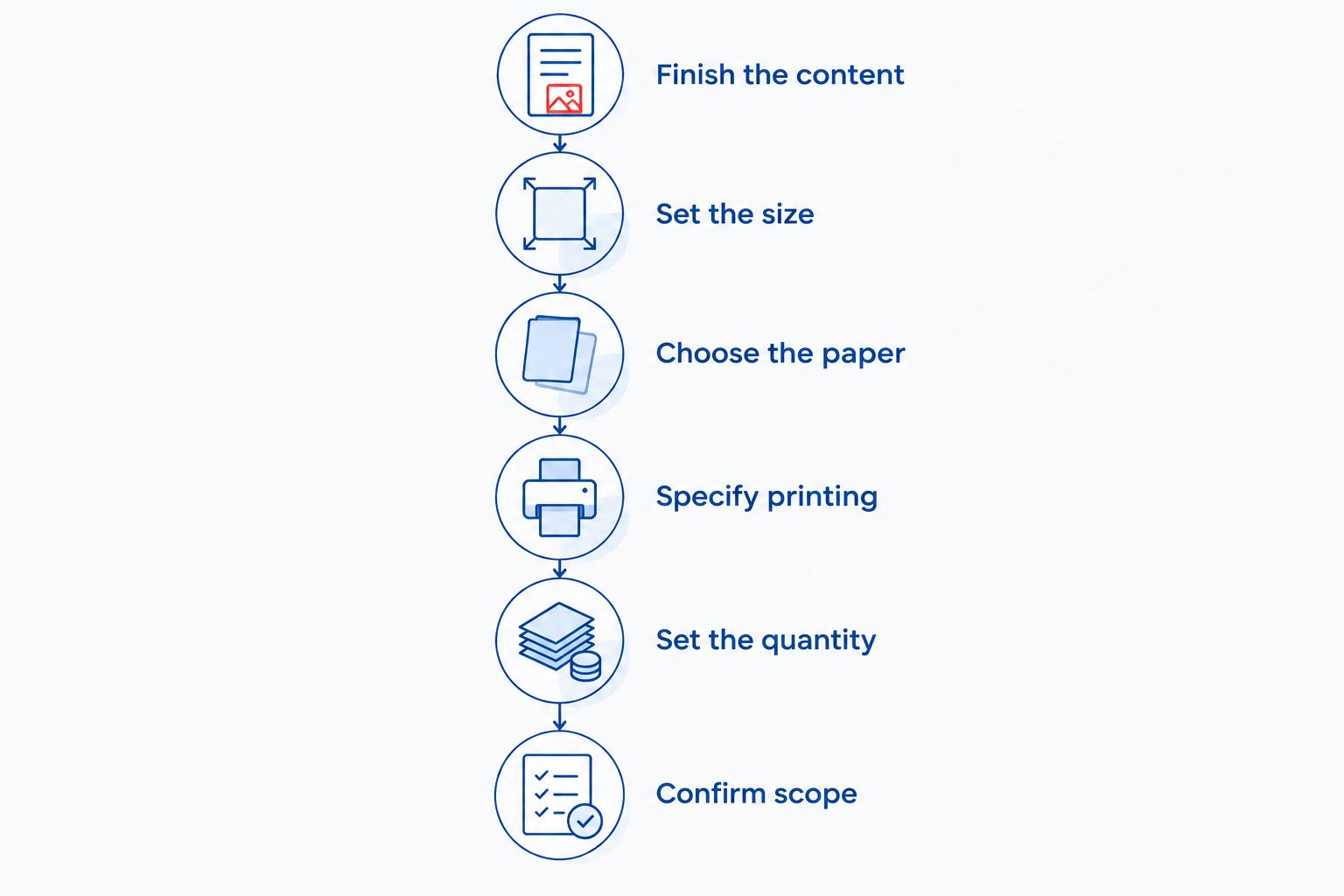
Keep that same specification when seeking another estimate. If a printer recommends a substitute paper or binding, record it as an alternative rather than silently replacing your original request.
Start with content and distribution. Remove duplicated material before shrinking type, and order against a realistic distribution plan rather than an attractive per-copy figure.
A lower per-copy figure does not automatically mean a lower order total. Buying additional booklets you cannot use is a different decision from reducing the cost of the quantity you need.
Next, check whether every color element serves a purpose. Color-coded instructions and product photographs have a different role from decorative accents; request a black-and-white alternative only if readers can still understand the content.
Finally, preserve readable type and usable margins. A booklet that technically holds all your text but is difficult to read has not solved your communication problem.
Reduce unnecessary content first, then evaluate the paper with the printer. Removing repeated material preserves readability, while changing paper affects opacity, feel, and folded thickness.
Do not use thinner paper as a substitute for checking binding suitability. Ask whether the complete booklet, including its cover, will fold and trim properly.
For a 2026 order, approve the physical specification and the final artwork together. Check that the estimate still matches the latest PDF, especially after revisions.
Publishing Xpress provides short-run digital printing, but the service category alone does not establish your project's final specifications. Keep your approved estimate and files together so the production instructions remain clear.
How much does saddle stitch binding cost in 2026?
Saddle stitch binding requires a project-specific quote based on your booklet specifications. Confirm whether the estimate covers complete printed booklets or binding alone, and check delivery and other exclusions.
Can I get a quote for binding without printing?
Ask the printer whether it accepts binding-only work before preparing materials. A complete booklet-printing service does not automatically mean customer-supplied sheets are accepted for binding.
Do blank pages count in a saddle stitched booklet?
Blank pages count toward the total because they occupy physical positions in the folded booklet. Conventional saddle stitch pagination uses multiples of 4 pages.
Does a saddle stitched booklet need a separate cover?
A saddle stitched booklet does not need a separate cover stock. A self-cover uses the same paper throughout, while a separate cover uses a distinct stock specified alongside the interior.
Is saddle stitch always cheaper than perfect binding?
The binding name alone does not establish which complete order has the lower total. Compare suitable formats using the same content, quantity, printing requirements, and delivery scope.
How many pages can saddle stitch binding handle?
The practical page limit depends on paper thickness, cover stock, and the printer’s equipment. Ask the printer to confirm suitability for your exact specifications rather than relying on a universal maximum.
Does Publishing Xpress offer saddle stitch booklet printing?
Publishing Xpress offers saddle stitch binding as part of its short-run printing services. Confirm your booklet’s page count, paper, finished size, and quantity when requesting an estimate.
Make a folded paper dummy before approving your 2026 booklet. Mark every page position, including blank inside covers, and turn through it as a reader would.
The useful surprise: a blank page is still a page. A paper dummy makes missing covers and awkward page sequences visible before they become part of your printed order.
© 2026 Publishing Xpress. All Rights Reserved.