October 20, 2026
Magazine printing in 2026 requires a project-specific quote: your quantity, page count, size, paper, color, and binding determine the total. Design, file corrections, delivery, and mailing also belong in your budget when they are not included in the printing quote. Compare the complete delivered order, not just the cost of a printed copy.
Your magazine printing total depends on the exact issue you order. A useful quote identifies the finished magazine specifications, the number of copies, and what happens after production. Without those details, a per-copy figure does not describe your project.
Start with a written specification, whether you request an estimate from Publishing Xpress or another printer. Use the same specification for every estimate so you can see what actually changes between proposals.
| Budget component | What to specify | What to confirm |
|---|---|---|
| Printed copies | Quantity, finished size, page count, and color | Whether the cover is counted separately |
| Paper | Interior stock and cover stock | Whether each quote uses equivalent paper |
| Binding | Saddle stitch or perfect binding | Whether the page count and stock suit the binding |
| File preparation | Finished PDFs and any requested corrections | Which preparation tasks the quote includes |
| Proofing | The proof method you need | What you must approve before production |
| Delivery and distribution | Destination and distribution method | Which shipping, handling, or mailing services are included |
Ask for both the order total and a clear description of what that total includes. A printing-only estimate and an estimate that includes delivery are not equivalent, even when their production specifications match.
Your magazine budget has to support the whole issue, not just its manufacture. Editorial work, photography, layout, printed copies, and distribution are separate decisions, even when you coordinate them together.
For a 2026 issue, decide how readers will receive the magazine before you finalize the format. Handing copies out at an event and mailing copies to individual readers create different packing and distribution tasks. Put those tasks in the plan rather than treating them as an afterthought.
Saddle stitching fastens folded sheets through the fold with wire staples. It suits thinner publications that do not need a printable square spine, such as community magazines, newsletters, and short editorial issues.
The page structure matters. A folded sheet creates 4 pages, so a conventional saddle-stitched magazine has a total page count divisible by 4. Ask how the printer counts the cover before you finish pagination.
The limitation is thickness. Paper bulk affects how well the folded issue closes, and nested sheets create creep: inner pages extend farther toward the outside edge before trimming. Keep page numbers and important content away from the trim edge, and follow the printer's layout instructions.
Choose saddle stitch when your magazine is thin enough for the selected paper and you do not need spine text. Do not assume a page limit from another printer applies to your stock.
Perfect binding attaches the pages to a wraparound cover with adhesive and creates a square spine. It suits thicker editorial issues, collected editions, and publications you want readers to shelve.
The spine is also the main production constraint. Its width depends on the final page count and paper thickness, so the cover cannot be sized accurately from the page count alone. Whether spine text fits depends on the resulting width and the printer's requirements.
Perfect-bound magazines also need sufficient inside margins. Content placed too close to the binding becomes harder to read, especially in photographs or graphics that cross the center spread.
Choose perfect binding when the issue has sufficient thickness and the square-spine format serves your publication. Finalize the interior paper and pagination before completing the cover.
| Binding | Best for | Main advantage | Main limitation |
|---|---|---|---|
| Saddle stitch | Thinner issues and folded magazines | Simple folded construction | No square spine for a printed title; thickness affects suitability |
| Perfect binding | Thicker issues and collected editions | Square spine and book-like format | Requires a correctly sized spine and adequate inside margins |
Neither binding is automatically the right budget choice. Ask for comparable estimates only when both methods suit your actual issue; an unsuitable binding is not a useful alternative.
These specifications define the production work. Keep them consistent when you compare printers, then change one at a time when you explore alternatives.
For your 2026 budget, separate these production specifications from scheduling and distribution requirements. Request the completion date and delivery arrangements explicitly; do not infer them from an order total.
A clear request helps you compare equivalent work and reduces clarification before production. Prepare the specification before uploading a draft that still has an unsettled page count.
The sequence matters: changing paper after sizing a perfect-bound cover changes the spine calculation. Changing trim size after layout can change pagination throughout the issue.
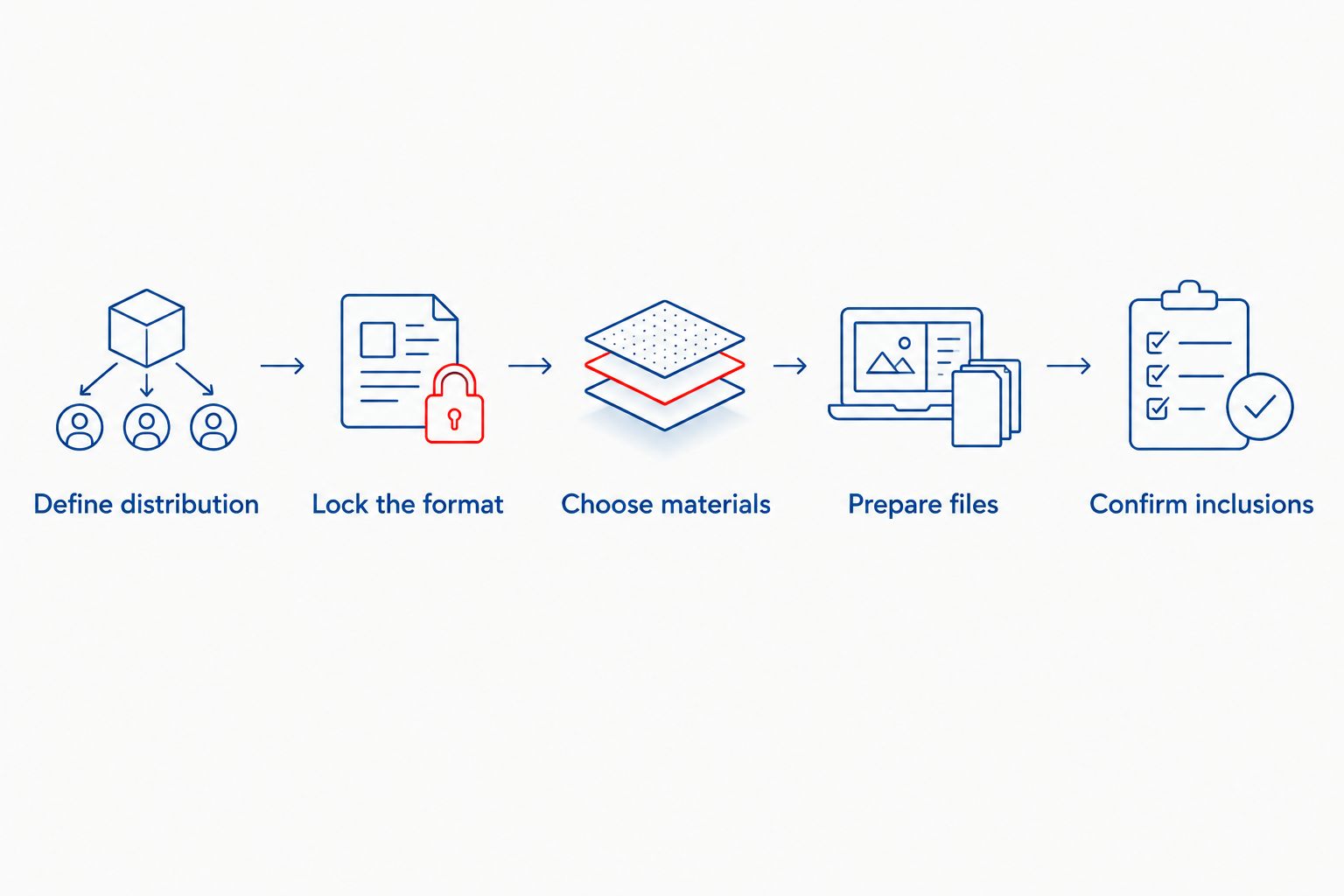
Protect readability and editorial purpose before removing production features. A magazine that no longer reproduces its photographs or communicates its content has lost the reason to print it.
Start with the distribution list. Order against a documented plan for readers, contributors, advertisers, and events rather than choosing an arbitrary surplus. A lower per-copy calculation does not justify copies you have no use for.
Next, review the layout. Remove accidental blank pages, repeated material, and oversized spacing before cutting useful articles. For saddle stitch, check changes in 4-page increments because the folded-sheet structure controls pagination.
Compare paper alternatives using samples when possible. A heavier sheet changes the feel and thickness, but weight alone does not tell you whether photographs, text, or reverse-side printing will look right.
For a text-led publication, consider whether a black-and-white interior serves the content. For a photography-led issue, assess color reproduction before making that change. Ask the printer to quote each alternative against the same quantity and finished size.
Finally, finish proofreading before approval. Correcting an error before production avoids choosing between distributing the mistake and arranging a corrected printing.
Your 2026 production file should match the specifications used for the estimate. A mismatch between the quoted page count and the final PDF changes the job you are asking the printer to produce.
Check these details before approval:
A PDF viewed at normal reading size also reveals issues that an enlarged design view hides. Check small captions, photo credits, and advertisement details before approving the issue.
A short run fits a publication with a defined, limited audience or an issue you want to test before committing to a larger distribution plan. It also limits the number of copies tied to content that will become outdated.
Publishing Xpress magazine printing is best for self-publishers, nonprofits, and organizations seeking short-run digital production. Publishing Xpress prints magazines in black-and-white or color without large minimum order requirements.
The trade-off is planning: a short initial run does not settle the specifications, schedule, or expense of a later reprint. Keep the approved PDFs and production details together so you can request the same issue again without reconstructing the job.
Plan your magazine printing
Set your quantity, page count, paper, color, and binding before requesting an estimate.
How much does it cost to print a magazine in 2026?
Magazine printing requires a project-specific quote based on quantity, page count, finished size, paper, color, and binding. Confirm whether file preparation, proofing, delivery, and mailing are included before comparing totals.
Is saddle stitch or perfect binding better for a magazine?
Saddle stitch suits thinner folded issues, while perfect binding suits thicker magazines that need a square spine. Paper thickness and page count determine whether each method fits your issue.
Does printing more magazines always save money?
Printing more magazines does not automatically improve your overall budget. Compare the complete order commitment with the number of copies you can distribute, not just the per-copy calculation.
How many pages does a saddle-stitched magazine need?
A conventional saddle-stitched magazine needs a total page count divisible by 4 because each folded sheet creates 4 pages. Confirm how the printer counts the cover and whether the selected paper suits the issue’s thickness.
Can I print a magazine with a black-and-white interior?
Yes, a magazine can have a black-and-white interior. Choose that treatment when the content works without color, and check photographs, charts, and advertisements in the exported PDF.
Does a magazine printing quote include mailing to readers?
A magazine printing quote includes mailing only when that service is explicitly listed. Confirm who handles addressing, packaging, postage, and distribution rather than treating delivery to your address as subscriber mailing.
What should I send a printer to get a useful estimate?
Send the quantity, finished size, page count, paper choices, color treatment, binding, destination, and required arrival date. State whether your production PDFs are final and ask which proofing and preparation tasks are included.
A blank page still belongs to the physical magazine. It affects pagination even when it contains no ink, and deleting it from a saddle-stitched file does not remove the requirement for complete folded sheets.
Before approving your 2026 issue, reconcile the PDF page count with the written order. The final file and the final specification should describe the same magazine.
© 2026 Publishing Xpress. All Rights Reserved.