October 19, 2026
Coil binding is priced for your specific document, so the useful answer is a quote based on page count, paper, covers, and quantity—not a universal per-book figure. A binding-only quote does not describe the same job as a quote that includes printing, and delivery or other charges need separate confirmation. For a 2026 budget, compare the complete job total and what it includes before choosing a printer.
Coil binding cost depends on the job specifications and the scope of the quote. Start by establishing whether you need an existing document bound or a complete book printed and bound. Those are different requests, even when the finished books look similar.
Use this breakdown when reading an estimate. Each line needs either an included amount or a clear statement that it does not apply.
| Quote component | What to confirm | Why it matters |
|---|---|---|
| Interior printing | Page count, color treatment, paper, and printed sides | Separates the printed pages from the binding work |
| Binding | Plastic coil, binding edge, and document thickness | Identifies the actual finishing method |
| Covers | Front and back cover materials and printing | Prevents unlike cover specifications from distorting comparisons |
| File preparation | Required corrections and whether they are included | Establishes who handles changes before production |
| Delivery and tax | Destination and applicable charges | Lets you compare the completed order rather than a partial subtotal |
File layout also belongs in the budget discussion. Review how to set up a spiral-bound book for printing before finalizing your document, so the binding edge is part of the design rather than an afterthought.
A workbook that stays open on a desk serves a different purpose from a book designed mainly for shelf display. Choose the function first, then compare quotes for the right format. Otherwise, you risk saving on a binding that does not suit the way readers use the book.
For your 2026 project, keep the specification beside the estimate. A total without its page count, paper choice, and quantity is not a useful reference for the next version of your book.
The same discipline helps when someone else approves the purchase. Send the specification with the quote so an author, department manager, or nonprofit board can see exactly what the proposed order includes.
A binding-only request starts with pages that are already printed. Ask whether the provider accepts customer-supplied pages, what condition those pages must be in, and which preparation tasks belong to you. Do not assume a printing company offers this service simply because it produces coil-bound books.
The binding edge needs particular attention. Holes occupy space along that edge, so text, writing lines, and diagrams must stay clear of the punching area. A page designed for an unbound handout is not automatically ready for coil binding.
Best for: a document you have already printed, provided the binding provider confirms acceptance and file or page suitability. The drawback is coordination: printing and binding are separate responsibilities, and problems with the supplied pages must be resolved before finishing.
A complete printing-and-binding request starts with your document files and ends with finished books. Specify the interior, covers, quantity, and binding together. This gives the printer a defined project rather than a request for an isolated finishing operation.
Publishing Xpress is a fit for self-publishers and organizations seeking short-run digital printing with plastic coil binding. Its printing options include black-and-white or color, and its binding options include plastic coil, Wire-O, saddle stitch, and perfect binding. You can review Publishing Xpress when planning the complete printed project.
Best for: authors and organizations that need pages printed and assembled into finished books. The trade-off is that your printing choices form part of the total; you cannot treat the complete estimate as the cost of the coil alone.
Before approving a 2026 printing quote, confirm that the specifications match your final files. An estimate for an earlier draft is not the specification for a revised, longer document.
The plastic coil is only part of the project. These factors define the work being quoted and help explain why estimates for different documents are not directly comparable.
Change one specification at a time when requesting alternatives. If you change the paper, quantity, cover, and color treatment together, the revised total will not tell you which change made the difference.
Build a short specification before contacting printers. You do not need printing jargon; you need a consistent description of the same book.
Keep the approved specification in one place. A forwarded email chain with conflicting page counts makes comparison harder than it needs to be.
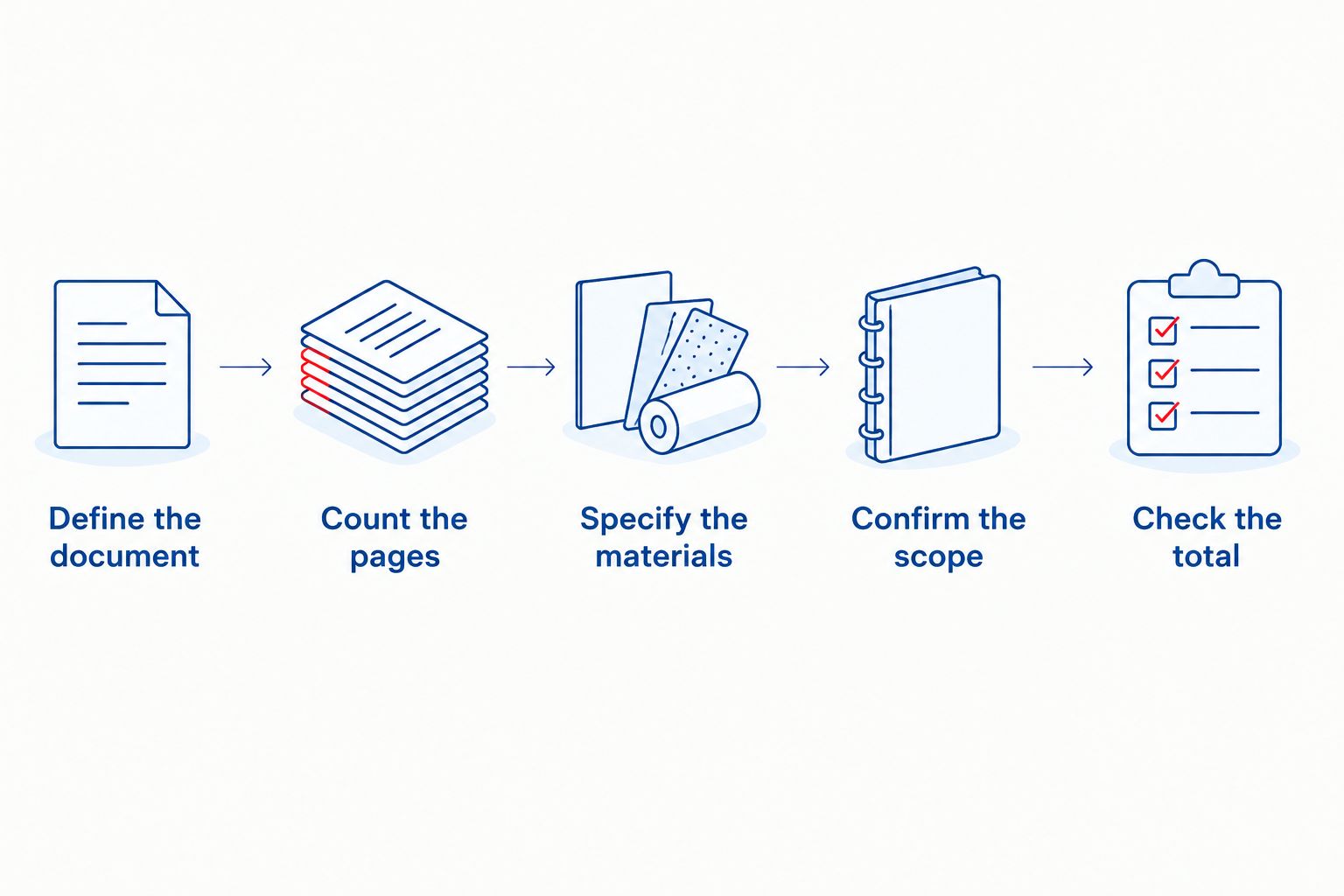
No. A page is one side of a sheet, while a sheet is the physical piece of paper. With double-sided printing, 1 interior sheet carries 2 pages; with single-sided printing, 1 interior sheet carries 1 printed page.
That distinction affects the stack being bound. Two documents with the same printed page count can have different physical thicknesses if one is single-sided and the other is double-sided.
Do not remove intentional blank pages merely to simplify the count. Tell the printer how the file should reproduce, and ask how its quotation process treats blanks and covers. Use the printer's counting convention consistently throughout the estimate and approval.
Compare matched quotes rather than assuming one binding is always cheaper. Plastic coil, Wire-O, perfect binding, and saddle stitch use different constructions. Their suitability also changes with the document's purpose.
| Binding option | Best for | Practical advantage | Trade-off |
|---|---|---|---|
| Plastic coil | Workbooks, recipe books, and working manuals | Pages open flat and fold back through 360 degrees | Exposed coil does not provide a printable book spine |
| Wire-O | Presentations, portfolios, and desk references | Pages open flat with a double-loop wire construction | Exposed wire needs protection from crushing |
| Perfect binding | Books intended for conventional shelf presentation | Creates a glued spine | Does not offer the same fold-back use as coil |
| Saddle stitch | Slim programs and booklets | Stapled construction suits booklet formats | Not suitable for every document thickness |
Plastic coil's fold-back function is useful when readers write, cook, teach, or follow instructions beside the book. It is less suitable when your priority is a titled spine visible on a bookshelf.
For a 2026 comparison, hold the interior, quantity, and cover requirements constant wherever the binding methods permit. Ask the printer to explain any necessary specification changes rather than treating every alternative as an identical product.
Start with unnecessary production requirements, not the features readers depend on. A workbook still needs room for writing, legible instructions, and clearance at the binding edge.
Review these decisions before approving the order:
Check the resulting total, not just one line item. A smaller order and a larger order answer different budget questions, and unused books still occupy storage space.
Do not shrink text or crowd the binding margin just to reduce page count. Approve a readable, usable layout first, then compare practical production alternatives.
Print a sample of a representative interior spread at its intended size. Check the writing areas, captions, tables, and anything placed near the binding edge. A screen preview does not show how your hand will use the page.
Keep important content clear of the hole area, and confirm the required clearance with the printer. There is no reason to guess a universal margin when the finished size and binding setup need to work together.
Finally, match the file name, page count, and revision to the approved specification. For a repeat order in 2026, verify that you are submitting the intended edition rather than relying on a familiar file name.
How much does coil binding cost for my book?
Coil binding requires a project-specific quote based on your document and the work included. Supply page count, paper, covers, quantity, and delivery requirements, and distinguish binding only from printing and binding.
Is spiral binding the same as plastic coil binding?
Spiral binding commonly refers to a continuous coil threaded through punched holes. Specify plastic coil when requesting a quote so the provider does not interpret your request as a different binding method.
Does a coil binding quote include printing?
A coil binding quote includes printing only when the stated scope says so. Confirm interior printing, covers, finishing, delivery, and applicable tax before comparing totals.
Can I fold a coil-bound book all the way back?
Plastic coil binding allows pages to fold back through 360 degrees. That makes it useful for workbooks and reference books used where desk space is limited.
Is coil binding always cheaper than Wire-O?
Coil binding is not a universal price winner over Wire-O. Request matched specifications and compare complete quotes rather than assuming the binding name determines the total.
Does Publishing Xpress offer coil-bound printing?
Publishing Xpress offers plastic coil binding as part of its printing services. Its other binding options include perfect binding, saddle stitch, and Wire-O.
Should I choose coil binding for a workbook?
Plastic coil is a practical choice for a workbook that needs to open flat or fold back. Its exposed binding does not provide the printable spine associated with a perfect-bound book.
Test the page your reader will use most, not just the cover. Place a representative worksheet, recipe, or instruction page on a desk and use it as intended. If the layout crowds your hand or puts essential content near the holes, fix that before approving production—the right binding cannot rescue an awkward page.
© 2026 Publishing Xpress. All Rights Reserved.