October 9, 2026
Wire-O binding takes the production time confirmed by your printer for your specific order; there is no single turnaround that applies to every book. For a 2026 project, get the production start point and completion date in writing, and confirm delivery separately. A production estimate is not an arrival date, so plan around when you need the finished books in hand.
The useful answer is the time between your printer’s stated production start and the point when your books are ready to leave the facility. Ask what triggers that start. Uploading a manuscript, placing an order, and approving a proof are different milestones; do not treat them as interchangeable.
Before requesting a schedule, review how to prepare files for Wire-O binding. Correct files give your printer a clearer basis for assessing the job and keep layout corrections out of the production conversation.
Use this sequence to get a usable answer:
The strongest scheduling question is not simply whether the printer can bind quickly. It is whether the printer can complete your exact job and get it to the right destination before your deadline.
A workbook that arrives after a class starts misses its purpose, even if the binding itself was completed on schedule. The same applies to presentation books, event materials, and books intended for a launch. Your deadline belongs at the delivery end of the schedule.
For 2026 planning, keep file readiness, production, and delivery separate. That distinction helps you identify what needs attention without assuming every delay comes from the binding equipment.
Wire-O binding is a finishing operation within a larger printing job. Pages must be printed, put in the correct order, prepared for the binding, and assembled into the finished book. Checking and packing also belong in your planning conversation.
The table below separates the milestones. It is a checklist for asking questions, not a promise about any printer’s workflow or timing.
| Milestone | What you need to establish | What it does not establish |
|---|---|---|
| File submission | The printer has the intended files | The files are accepted for production |
| File review | Required corrections are identified or resolved | You have approved the final appearance |
| Proof approval | The version to print is agreed upon | The books are already being bound |
| Printing and finishing | The physical books are being produced | The shipment has left the facility |
| Shipment | The books have been handed to the carrier | The books have arrived at your destination |
| Receipt | The shipment is in your hands | You have checked and distributed the books |
Ask which milestone the quoted turnaround measures. A schedule that ends at shipment needs a separate delivery plan, while a schedule tied to receipt needs a clear destination.
Do not assume uploading files starts production. Ask your printer to name the start condition, including any file acceptance, proof approval, or order confirmation requirements.
Keep that answer with the job details. If you replace the files later, ask whether the replacement changes the agreed schedule before approving the new version.
Binding time is not the same as total printing turnaround. Wire-O binding joins the prepared pages and covers, but the complete order includes other work before and after that operation.
Ask for the finished-order schedule rather than the equipment time alone. You need usable books, not an estimate of how long one machine handles them.
Treat shipping as separate unless your printer explicitly includes it in the stated date. A book ready to ship is not a book ready to hand out.
For an event, specify the location where you will receive the shipment. An office delivery and a venue delivery are different instructions, even when both serve the same project.
Wire-O binding does not turn an unfinished manuscript into a finished book by itself. The job’s specifications and approval status shape the work that needs to happen. Confirm these factors instead of assigning an unsupported number of days to each one:
Do not rank these factors by assumed delay. Ask the printer which unresolved detail prevents a firm schedule for your particular order.
Changing the page count can change the book’s thickness. Changing the size changes the layout. Neither is just a wording edit, so resolve those decisions before final approval.
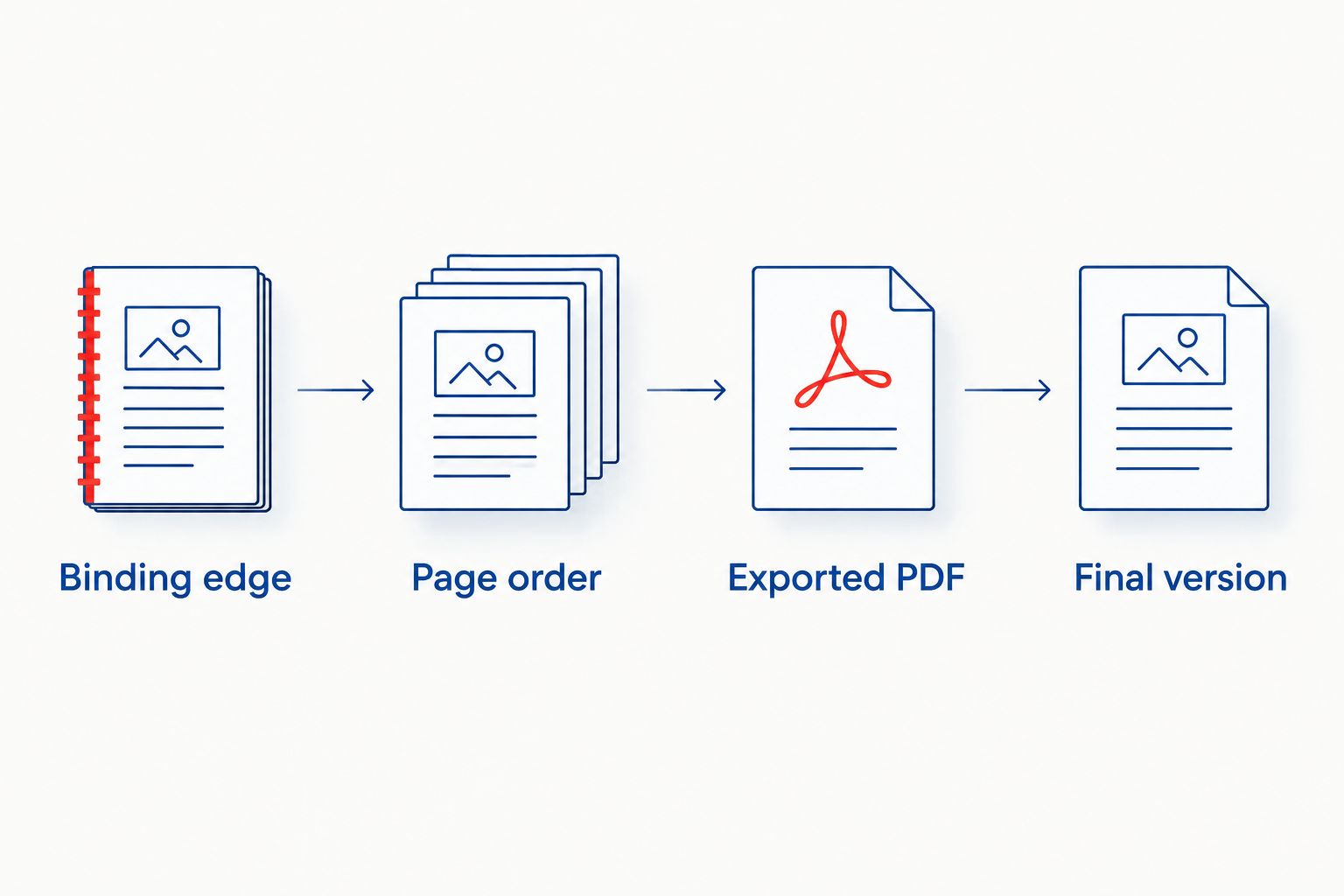
For your 2026 order, maintain a single specification sheet alongside the approved files. Include the binding edge so everyone understands which side of the document will be punched and bound.
A committee can review a book, but the printer needs a clear approval decision. Assign a person to collect feedback and identify the version that is ready to print.
Finish editorial disagreements before that decision. Asking the printer to hold the job while contributors rewrite sections makes the production date harder to settle.
Your printer can assess a defined job more clearly than a description of a book you are still designing. Prepare the actual interior and cover files, then check them against the printer’s current requirements. Do not substitute general formatting advice for those instructions.
Keep text, page numbers, and important image details clear of the area needed for punching. Use the printer’s required binding-side margin rather than copying a margin from a differently bound book.
Check both left-hand and right-hand pages. A layout that looks balanced on screen still needs room for the physical binding at the correct edge.
Review the exported file from beginning to end. Confirm that the cover, contents, sections, worksheets, and any intentional blank pages appear where you expect them.
Blank pages deserve deliberate review. A blank writing page and an accidental empty page look similar in a file, but they lead to different finished books.
Review the PDF you will submit, not only the editable document. Check font appearance, image placement, page dimensions, and the position of content near the trim and binding edges.
Open the file after export and inspect representative pages as well as the beginning and end. Correct the source document, export again, and clearly identify the replacement file.
Use a filename that distinguishes the approved file from earlier drafts. Keep the same version reference in your approval message so there is no uncertainty about which document you mean.
Archive older drafts away from the submission folder. The goal is simple: everyone should be able to identify the intended interior and cover without guessing.
Start with the date the books must be available for use. Then establish the delivery plan, the required completion date, and the approval deadline with your printer. Working backward makes the relationship between these milestones explicit.
For a 2026 class or event, include time to receive and inspect the shipment before distribution. Choose that allowance according to your project; do not treat an arbitrary buffer as a printer’s guarantee.
Give your printer a concise description that includes:
Ask for confirmation against that brief. Keep the response with the approved specifications so a later change does not silently replace the original agreement.
A conference date is fixed; a preferred release date sometimes has flexibility. Tell the printer which kind of deadline you have instead of simply asking for the fastest turnaround.
If the timing does not fit, discuss the project before approving it. Do not assume that faster shipping can compensate for an unresolved production schedule.
Choose Wire-O for how the book will be used, then confirm whether the production schedule fits. Wire-O books open flat and allow pages to fold back, which suits materials you consult while working or writing. The exposed metal binding is also a physical feature to consider when packing and handling the books.
| Wire-O consideration | Practical advantage | Limitation to account for |
|---|---|---|
| Flat opening | Keeps reference pages open during use | The layout still needs clearance for punched holes |
| Fold-back pages | Lets you work with one page visible | Important content must stay clear of the binding edge |
| Metal binding | Creates a distinct, structured bound edge | The exposed wire can deform if crushed |
| Finished-book format | Suits hands-on reference and writing tasks | Format alone does not establish production speed |
A tight deadline does not make another binding automatically faster. Compare actual schedules for the same project specifications before changing the format.
Publishing Xpress is a fit for self-publishers and organizations seeking short-run Wire-O book printing. Its services include black-and-white and color digital printing, Wire-O binding, and orders without large minimum requirements.
The practical advantage is being able to plan a short printed run around your project. The limit is equally important: that service description does not establish a completion date for your order. Confirm the specifications and schedule directly with Publishing Xpress before committing to a deadline.
Bring the final files and your required arrival date to that conversation. A defined project gives you something concrete to approve rather than a general expectation about speed.
How long does wire-o binding take for a short-run book?
Wire-O binding takes the production time your printer confirms for the specific short-run order. Ask what starts that schedule and whether the stated completion point includes packing or shipment.
Does Wire-O turnaround include delivery?
Wire-O turnaround includes delivery only when the printer explicitly says it does. Confirm the shipment date and the expected arrival separately before planning distribution.
Can I get Wire-O books produced faster by sending finished files?
Finished files remove unresolved editing and layout work from your submission. They do not establish a faster production promise; confirm the schedule after the printer reviews the job.
Can I change pages after approving a Wire-O book?
Ask the printer before changing pages after approval. A replacement file needs a clear version reference and confirmation of its effect on the production schedule.
Is Wire-O binding faster than other binding methods?
Wire-O binding is not automatically faster than another binding method. Compare confirmed schedules for the same quantity, files, and printing specifications rather than judging speed from the binding name.
Does Publishing Xpress print Wire-O books?
Publishing Xpress offers Wire-O binding and short-run digital printing in black-and-white or color. Confirm the current production schedule for your particular book before setting an arrival deadline.
What should I ask before ordering Wire-O books in 2026?
For a 2026 Wire-O order, ask what starts production, when the finished books will be ready, and how delivery is handled. Supply final specifications, the destination, and your required in-hand date.
The most useful date is the day you can inspect the finished books, not the day they leave the printer. Receiving them gives you the opportunity to check page order, binding, and quantity before readers or attendees need them.
Put that inspection point on your project calendar. It connects the printing schedule to the actual purpose of the order.
© 2026 Publishing Xpress. All Rights Reserved.