October 1, 2026
Bed and breakfast cookbook printing is turning your inn’s recipes into a bound book with the aim of giving guests a keepsake they can cook from at home. Unlike a general recipe collection, your cookbook needs to preserve the breakfast experience while translating kitchen routines into instructions a home cook can follow.
A bed and breakfast cookbook connects a particular meal with a particular place. Your introduction can explain the setting, but the recipes must deliver the experience without your staff standing beside the reader.
That creates two jobs: tell the inn’s story and make the food reproducible. A beautiful breakfast photograph cannot compensate for a missing oven setting, an unclear pan size, or instructions written for commercial equipment.
Start with book printing for cookbooks and recipe collections as the production category, then make decisions around your own guest experience. A book intended for everyday cooking needs different handling from a photo-led souvenir.
For your 2026 edition, choose the book’s purpose before choosing its appearance. If guests are meant to cook from it, readable instructions and an open, usable page come first. You can add atmosphere without making the recipes harder to use.
Write a simple project brief in a document you already use. Name the reader, the intended use, and the breakfast memories you want the book to preserve; this keeps recipe selection from becoming a collection of everything your kitchen has ever made.
Decide whether you are creating a guest gift, a book to sell at the inn, or a collection for a special occasion. Those purposes affect how you present the story and how you plan distribution, but none requires you to begin with a large collection.
Separate guest-facing content from internal kitchen instructions. Supplier notes, staff assignments, and service shortcuts belong in your operations documents, not in a cookbook for someone cooking breakfast at home.
Create a recipe template before you start page design. Include yield, ingredients, equipment, preparation, cooking instructions, and a clear description of when the dish is ready; use the same order throughout the book.
An inn-sized recipe does not become a home recipe simply by dividing every ingredient. Pan depth, mixing method, and cooking conditions also matter, so test the intended household version with equipment your reader can reasonably use.
Ask someone other than the recipe’s author to cook from the written instructions. The test is whether the page works without spoken help. Record questions as editing tasks rather than assuming readers will fill in the gaps.
For the 2026 manuscript, keep test notes separate from the approved recipe text. This prevents an earlier ingredient quantity from finding its way back into the layout.
Make a paper mock-up first. Fold or stack printed sample pages, place them on a counter, and check whether the reader can see the ingredients and method together without repeatedly turning pages.
Publishing Xpress is best for bed and breakfasts that need short-run cookbook printing with a choice of four binding styles. Publishing Xpress offers black-and-white or color printing with perfect bound, saddle stitch, Wire-O, and plastic coil binding, without large minimum order requirements.
Plastic coil and Wire-O let pages lie flat, which makes them strong choices for a working cookbook. Perfect binding provides a glued spine, but it does not offer the same hands-free handling; saddle stitch suits a slimmer collection rather than an expanding recipe archive.
The printing service handles production, not the task of proving your recipe instructions. Finish recipe testing before treating a print-ready file as a finished book.
Use a word processor or page-layout application you already know to build a sample spread. Start with a 2-page mock-up containing a short recipe and a longer recipe; that test exposes spacing problems before you repeat the design throughout the book.
Keep ingredient lists visually distinct from instructions. A reader should be able to find the next ingredient while standing at the counter, not search through a paragraph about the inn’s history.
Check the actual printed size rather than relying on a zoomed-in screen. Leave space near the binding edge so text does not disappear into a glued gutter or interfere with punched holes. Follow the printer’s specifications rather than applying a margin intended for another binding.
For your 2026 layout, create reusable styles for recipe titles, ingredient lists, methods, and notes. Consistency makes later corrections easier and helps readers recognize where each kind of information belongs.
Print representative photographs on your own printer to check composition and legibility, then evaluate the intended production paper through a physical sample or proof. An office printout helps with layout, but it does not establish how the final paper will reproduce the image.
Choose photographs that explain the recipe or establish the setting. A finished dish, a useful preparation detail, or the breakfast table can earn its place; a decorative image that crowds out instructions does not.
Paper selection involves readability, image reproduction, and handling. A coated sheet and an uncoated sheet have different surfaces, but neither description alone tells you how your specific photographs will look. Avoid treating a paper finish as a promise that the book can withstand spills.
Export a PDF using the printer’s current instructions, then inspect the exported file rather than only the source document. Check that the page size, fonts, images, and page order survived the export; corrections in the manuscript do not count unless they appear in the submitted PDF.
Review interior and cover requirements separately. A perfect-bound cover depends on the finished book’s spine, while punched bindings need adequate clearance along the binding edge. Do not reuse a cover file from a different format without checking it.
Use a 3-pass review: recipes first, layout second, and production details third. These are separate checks because a correct ingredient list can still be cut off by a bad margin, and a correctly sized page can still contain an untested recipe.
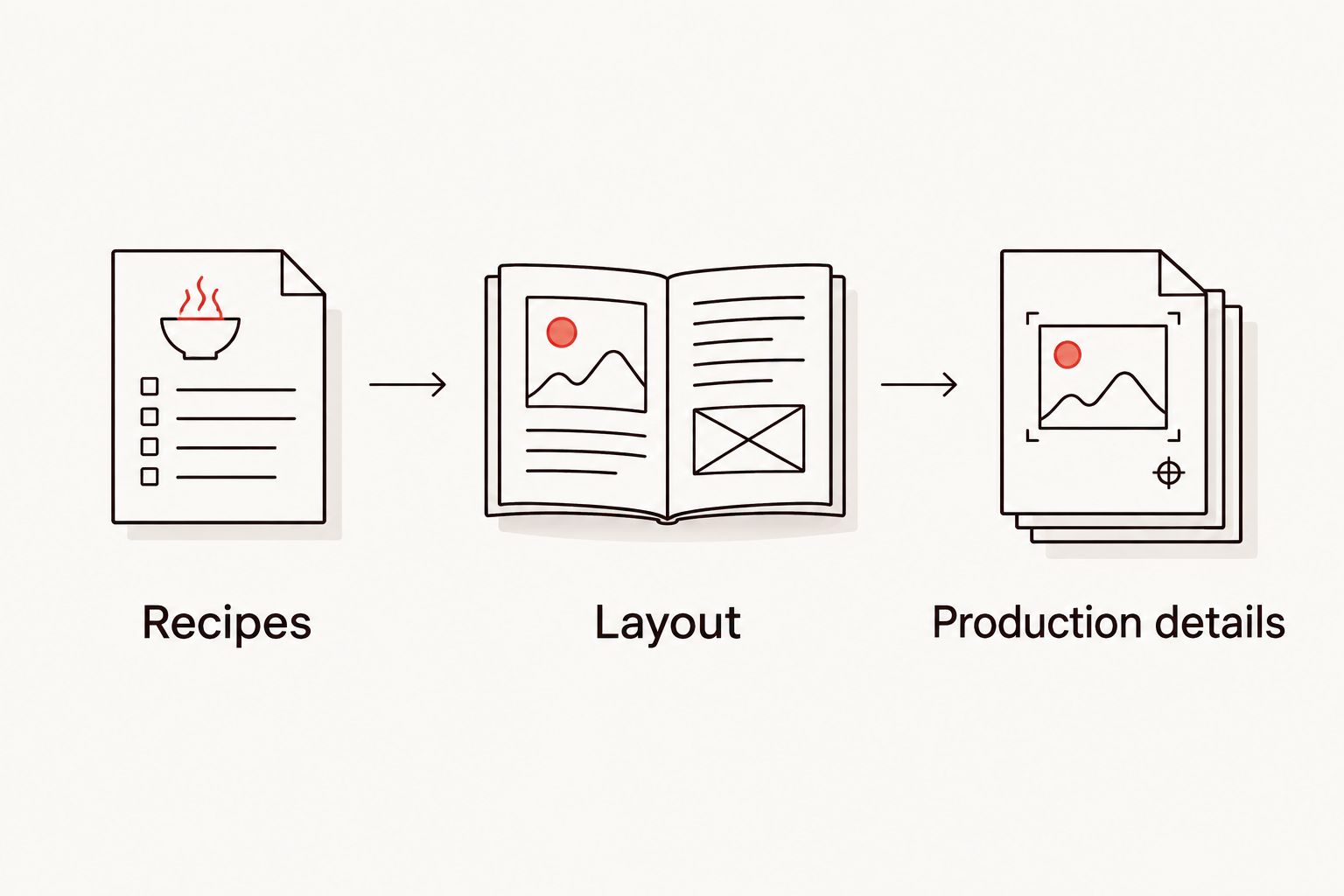
Before approving your 2026 files, inspect the first recipe, a middle spread, and the final page. Then check the rest; those checkpoints are a starting point, not a substitute for a full review.
Print 1 full-size reading copy before production, and ask the printer what physical proof options apply to your project. Read the pages at a kitchen counter, turn them with the book open, and check whether each recipe remains usable in that position.
Separate a bound guest keepsake from an updateable kitchen collection. Unlike a fixed book, recipe binders and boxes let cooks add or replace individual recipes, so keep changing staff notes outside the guest edition rather than forcing frequent revisions into it.
Build the initial order from a written distribution plan. Count copies assigned to gifts, on-site sales, contributors, and your own archive, rather than assuming every occupied room translates into a cookbook request.
Keep a dated approval record and a clean master file. If you correct a recipe after the 2026 edition, identify the revised version clearly before reprinting.
Publishing Xpress cookbook printing offers four binding choices. Choose by how the guest will use the book, not by which cover looks most impressive on a screen. The limitations below matter as much as the benefits.
| Option | Best for | Main benefit | Key limitation |
|---|---|---|---|
| Plastic coil | Guests cooking directly from the book | Pages lie flat and can fold back | The exposed coil does not provide a conventional printed spine |
| Wire-O | Countertop recipe use with flat-opening spreads | Pages lie flat for hands-free reading | Exposed wire loops can bend if crushed |
| Perfect bound | Shelf-oriented souvenirs and story-led collections | A glued spine gives the book a conventional paperback form | The book does not stay open like a punched binding |
| Saddle stitch | A slim selection of signature breakfast recipes | Staples hold a compact booklet together | It is not suited to a thick, expanding collection |
If your cookbook combines stories and recipes, test the recipe pages rather than judging only the cover. A guest can enjoy the inn’s history while seated, but cooking asks more of the binding and layout.
A recipe that works during breakfast service still needs testing for home use. Rewrite equipment references and test the household yield before publishing; do not leave guests to calculate the conversion while cooking.
The property’s history belongs in an introduction, section opening, or short recipe note. Keep it outside the instructions so readers do not lose their place between preparing ingredients and using them.
A shelf-friendly format and a counter-friendly format solve different problems. If your main promise is that guests can recreate breakfast, prioritize flat-opening pages; choose a conventional spine only when that trade-off fits the book’s purpose.
Write your own instructions and confirm rights to photographs and contributed text. Credit alone does not replace permission to reproduce someone else’s protected writing or images, and a staff contribution needs a clear agreement about publication.
Room bookings do not establish cookbook demand. Use recorded guest requests, planned gifts, and actual sales to guide repeat orders, then update the distribution plan when those records change.
What is custom cookbook printing for bed and breakfasts?
Custom cookbook printing for bed and breakfasts turns an inn’s recipes and stories into a printed guest cookbook. The project includes recipe testing, page design, binding selection, file preparation, and proofing.
What is the best binding for a bed and breakfast cookbook?
Plastic coil or Wire-O is best when guests will cook with the book open on a counter. Perfect binding suits a shelf-oriented keepsake, while saddle stitch fits a slimmer recipe collection.
Can Publishing Xpress print a small cookbook order?
Publishing Xpress offers short-run digital printing without large minimum order requirements. It provides black-and-white or color printing and four binding options; confirm the requirements for your particular cookbook before preparing final files.
Should an inn cookbook include photographs of every recipe?
No, an inn cookbook does not need a photograph of every recipe. Include images that explain a dish or preserve the breakfast setting, and give readable instructions priority over decorative pictures.
Can I use recipes written for my inn’s kitchen?
Yes, but test and rewrite them for the intended home-kitchen yield before publication. Check equipment, ingredient quantities, method, and doneness rather than relying on arithmetic alone.
Do I need permission to include contributed recipes and photos?
Confirm permission for contributed text and photographs before printing. Write original instructions and keep a record of what each contributor has authorized you to publish.
How do I decide how many guest cookbooks to print?
Base the order on a written distribution plan rather than occupancy alone. Separate planned gifts, on-site sales, contributor copies, and archive copies, then use actual requests and sales to guide reorders.
Test whether someone can cook breakfast using only the printed page. Put a sample recipe beside the ingredients and let a reader follow it without coaching; every question reveals something the book needs to explain.
For your 2026 cookbook, that kitchen test is more valuable than another decorative page. The keepsake earns its place when guests can bring part of their stay home and make it work.
© 2026 Publishing Xpress. All Rights Reserved.