November 4, 2026
Best overall for spiral bound workbook printing: Publishing Xpress with plastic coil binding. Choose Wire-o Printing for instructor editions, Saddle Stitch Printing for short practice tests, and Perfect Bound Printing for reference-heavy study guides; this 2026 guide compares those services by how students use the finished book.
A test-prep workbook is a working tool, not just a book students read. Students need room to calculate, mark passages, compare explanations, and turn pages without losing their place.
Publishing Xpress is best for test-prep companies ordering spiral bound workbook printing in batches of at least 25 copies. The practical choice is plastic coil for student exercises, with other bindings reserved for materials that serve a different purpose.
This is a comparison of binding-specific printing services, not an unsupported ranking of competing printers. Start with the student’s task, then choose the service that fits it.
Use these criteria to evaluate your 2026 workbook order before comparing quotes:
A useful comparison keeps the interior specifications consistent. Changing the paper, page count, color treatment, and binding at once makes it harder to identify what each choice contributes.
| Printing service | Best for | Standout feature | Key limitation |
|---|---|---|---|
| Plastic Coil Printing | Student practice workbooks | Lies flat and folds back | Punched edge requires clear space |
| Wire-o Printing | Instructor editions | Paired metal loops and flat opening | Wire loops can deform if crushed |
| Saddle Stitch Printing | Short diagnostic tests | Stapled folded sheets without an external coil | Maximum 80 pages at Publishing Xpress |
| Perfect Bound Printing | Reference-heavy study guides | Glued, squared spine | Does not provide coil-style flat opening |
The table separates distinct jobs rather than treating every binding as interchangeable. Only plastic coil is the spiral-bound default here; the remaining services are alternatives for companion materials.
Plastic Coil Printing uses a continuous plastic spiral threaded through holes along the binding edge. The pages lie flat, and students can fold the workbook back to work on a single page.
That makes plastic coil the strongest default for calculation drills, reading annotations, and written explanations. Choose this service when students spend more time answering questions than reading uninterrupted text.
Plastic Coil Printing pros:
Plastic Coil Printing cons:
Best for: Student editions used throughout a test-prep course.
For a 2026 edition, establish the binding margin before laying out dense problem sets. Moving an entire workbook’s answer boxes after pagination is finished creates avoidable rework.
Do not mistake fold-back capability for a cure for cramped design. A student still needs enough space to write beside the binding edge, particularly when solving longer problems.
Verdict: Buy Plastic Coil Printing for the main student workbook.
Wire-o Printing holds punched pages with paired metal loops rather than a continuous plastic spiral. The book opens flat and folds back, making it suitable for an instructor who moves between questions, teaching notes, and answer explanations.
Choose Wire-o when you want a distinct instructor edition with the same practical page access as a working manual. Confirm the binding choice before preparing the final files; plastic coil and Wire-o are not interchangeable specifications.
Wire-o Printing pros:
Wire-o Printing cons:
Best for: Instructor editions used at a teaching desk or lectern.
Keep teaching notes clearly separated from student-facing questions. A binding change alone will not prevent an instructor from accidentally distributing an answer-bearing edition.
Verdict: Buy Wire-o Printing for a separate instructor workbook; keep plastic coil as the student default.
An open workbook should give your hand access to the whole answer area. The binding supports that task, but the page layout determines whether the writing space is actually usable.

Saddle Stitch Printing secures folded sheets with staples through the fold. It is an alternative for a short placement test, diagnostic assessment, or focused practice module—not a spiral-bound substitute for every workbook.
Publishing Xpress offers saddle stitch books up to 80 pages. Check the final page count, including instructions and answer explanations, before choosing this service.
Saddle Stitch Printing pros:
Saddle Stitch Printing cons:
Best for: Short diagnostic tests and standalone practice modules.
For a 2026 assessment series, treat each booklet as a complete unit. Include the instructions students need in that booklet rather than assuming the main workbook will always be beside it.
Verdict: Buy Saddle Stitch Printing for short assessments; skip it for a long course workbook.
Perfect Bound Printing attaches the interior pages to a cover with adhesive along the spine. It produces the familiar paperback format and suits materials students primarily read rather than write in.
Choose perfect binding for strategy explanations, content reviews, and reference chapters. Keep the working exercises in a separate coil-bound volume when flat writing access is essential.
Perfect Bound Printing pros:
Perfect Bound Printing cons:
Best for: Reading-heavy companion guides.
Avoid choosing perfect binding simply because it looks like a conventional textbook. A workbook that closes while students calculate fails its main job, regardless of the cover design.
Verdict: Buy Perfect Bound Printing for the companion reference guide; skip it for a writing-first workbook.
For your 2026 print files, review the workbook in the order it will be used: instructions, questions, writing areas, and explanations. The spiral-bound book setup guide covers the format-specific preparation behind that review.
Place writing areas away from the punched edge. Apply the same check to the reverse side of each sheet; a comfortable outside margin on one page becomes an inside margin on the next.
The principle also applies to custom notebook printing: usable writing space matters more than decorative borders around it. In a test-prep workbook, protect room for calculations, revisions, and notes before adding visual extras.
Keep a question with the diagram, passage, or table needed to answer it whenever the layout permits. Avoid making students repeatedly flip between a prompt and its supporting material during timed practice.
Check that answer explanations refer to the final question numbers. An edit that moves or removes a question must also update the answer key and any instructor references.
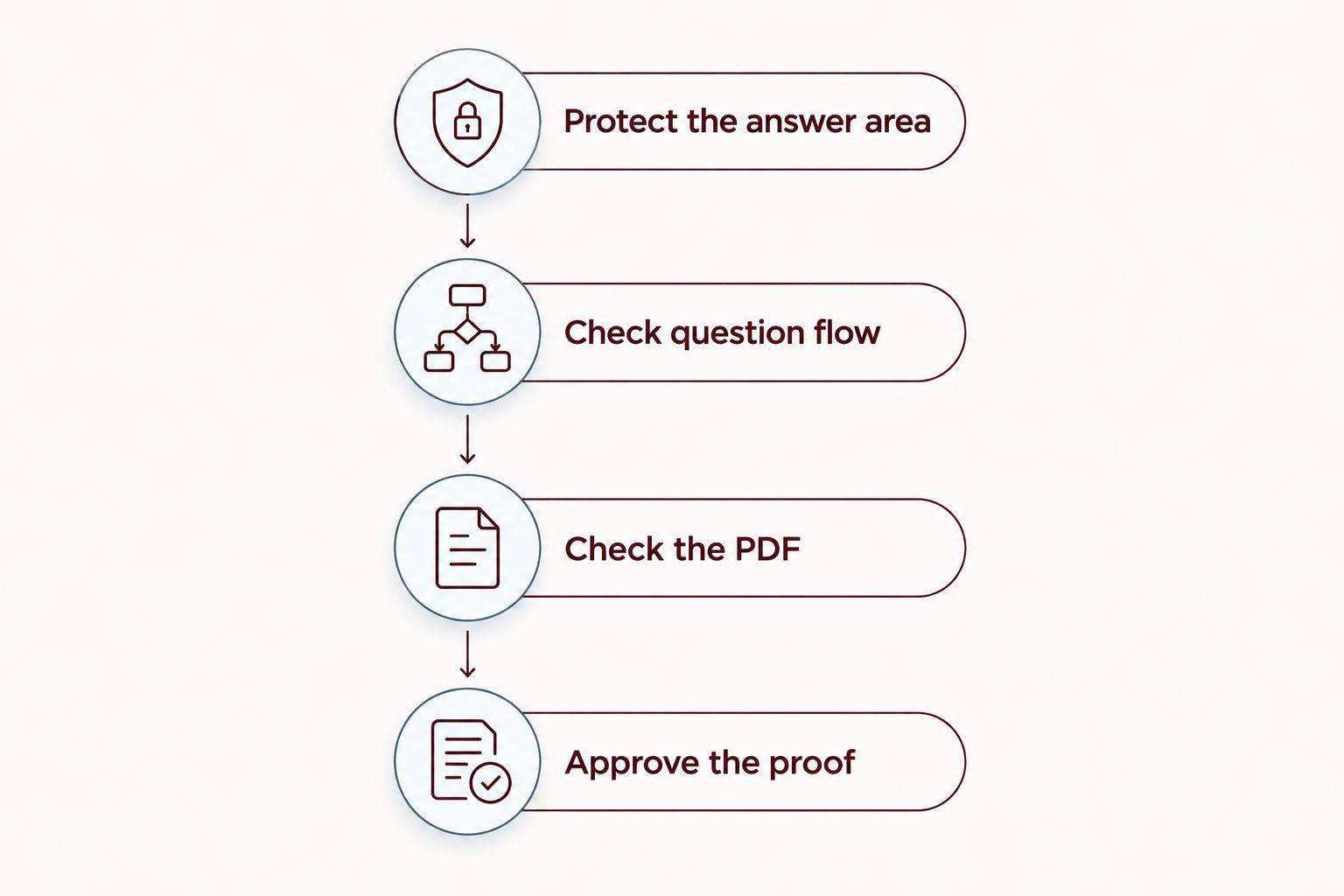
Inspect the exported PDF, not just the source document. Confirm font appearance, mathematical symbols, image clarity, page order, and intentional blank pages.
Use the printer’s requirements for bleed, margins, and file submission. Do not copy a generic margin measurement into the file without confirming that it fits the selected binding.
Give content and production checks separate attention. Verify the answers first, then inspect placement, page sequence, and binding clearance before approving the proof.
Publishing Xpress has a 25-copy minimum and ships in 4 to 6 days after proof approval. Shipping is not the same as arrival, so build your class schedule around delivery rather than the dispatch date alone.
For a 2026 course launch, work backward from the date instructors need the books. Allow separate time for content review, corrections, proof approval, production, transit, and receiving.
Do not approve an unfinished answer key to start the production clock. A printed correction becomes a distribution task as well as an editorial task.
The ranking prioritizes writing access, page movement, binding clearance, readability, order fit, and approval scheduling. Plastic coil comes first because this page addresses workbooks students write in, not books they primarily read.
Wire-o earns the instructor slot through flat opening and fold-back use. Saddle stitch serves short assessments, while perfect binding serves reading-heavy guides. These are recommendations by task, not claims of measured performance or market-wide superiority.
Choose plastic coil if you are undecided. It directly supports the defining task of a test-prep workbook: keeping a page open while a student writes.
Keep the other services tied to specific companion materials. Wire-o fits an instructor edition, saddle stitch fits a short assessment within the page limit, and perfect binding fits a reference guide.
Before ordering, settle the binding, interior layout, edition files, quantity, and arrival deadline. Those decisions matter more than adding another format to the shortlist.
What is the best binding for a test-prep workbook?
Plastic coil is the best default for a test-prep workbook students write in. It lies flat and folds back, giving students access to individual exercise pages without holding a glued spine open.
Are spiral binding and plastic coil binding the same thing?
Plastic coil is a type of spiral binding that uses a continuous plastic spiral through punched holes. Specify plastic coil when ordering so the binding is not confused with Wire-o, which uses paired metal loops.
What is the minimum order for spiral bound workbook printing?
Publishing Xpress has a minimum order of 25 copies. Match the order to your current course edition and enrollment needs.
Is Wire-o better than plastic coil for student workbooks?
Plastic coil is the default recommendation here for student workbooks; Wire-o is the instructor-edition alternative. Both open flat and fold back, but their binding structures differ, and metal Wire-o loops can deform if crushed.
Can I use saddle stitch for a practice test booklet?
Yes, saddle stitch suits short practice test booklets. Publishing Xpress offers saddle stitch books up to 80 pages, so include instructions and explanations when checking the final count.
How long does workbook printing take after proof approval?
Publishing Xpress ships in 4 to 6 days after proof approval. Allow additional time for transit and receiving rather than treating the shipping date as the arrival date.
Should a study guide and workbook use the same binding?
No, choose the binding separately for each job. Plastic coil suits written practice, while perfect binding suits a companion guide students primarily read.
Check the first exercise page after every section divider. A new section can restart page numbering or introduce a different layout, so inspect those transitions before approving the full workbook.
Then have an instructor follow a question through to its answer explanation in the final PDF. That simple check connects the printed question, the answer key, and the teaching workflow before copies reach students.
© 2026 Publishing Xpress. All Rights Reserved.