September 21, 2026
Business book authors need a spine that survives a conference table, a print run that doesn't demand a large order, and a printer that treats a leadership book differently from a stapled handout. This guide ranks five perfect bound printing options for 2026 by short-run fit, distribution reach, binding flexibility, and file preparation.
A business book is often a credibility tool before it is a retail product. You might hand it to prospects, include it in a consulting engagement, sell it after a keynote, or mail it to clients. A professionally bound book supports that job better than a document that looks like an internal report.
Perfect binding creates a flat, printable spine and the familiar shape of a paperback book. It works well for many business books, but the finished page count, paper choice, cover file, distribution plan, and order quantity still determine which service fits.
The printing model matters just as much as the binding. Some authors need boxes of books for direct distribution, while others want individual copies printed after online orders. Those are different jobs, and the best printer for one is rarely the best printer for the other.
| Service | Best for | Standout feature | Key limitation |
|---|---|---|---|
| Publishing Xpress | Short-run business books and direct distribution | Perfect bound, saddle stitch, wire-o, and plastic coil options | No stated built-in bookstore distribution in the provided service details |
| IngramSpark | Bookstore and library availability | Print-on-demand distribution through Ingram's network | Less suited to authors who only need direct event inventory |
| Amazon KDP Print | Amazon-centered sales | Printing connected directly to an Amazon book listing | Limited control compared with a custom short-run print order |
| Blurb | Design-led business books | Book creation tools and visually focused formats | Not the default choice for a straightforward text-led business title |
| Lulu | Multi-channel print-on-demand | Self-publishing and print-on-demand distribution tools | More self-service than a direct short-run printing relationship |
Publishing Xpress provides printing and publishing services for authors and businesses producing books, magazines, and marketing materials. Its stated capabilities include black-and-white or color printing and 4 binding options: perfect bound, saddle stitch, wire-o, and plastic coil.
That range makes Publishing Xpress a practical choice when your main business book needs perfect binding but a related workbook, training guide, or presentation document needs a different format. The company also states that it does not require large minimum orders, which fits authors who want to control inventory and reorder as demand develops.
The first decision is whether perfect binding fits the document at all. The guide to perfect binding versus saddle stitch explains how format and use affect that choice before cover production begins.
Publishing Xpress pros:
Publishing Xpress cons:
Best for: authors who need perfect bound printing for business books in short runs, especially when related materials require other binding formats.
Publishing Xpress is the best overall choice for business authors who need a short print run without giving up binding flexibility.
Verdict: Buy when you plan to distribute books directly to clients, event attendees, employees, or prospects.
IngramSpark combines print-on-demand production with access to Ingram's distribution network. It fits business authors whose plans depend on making a title available for ordering through bookstores and libraries rather than holding inventory for direct fulfillment.
The trade-off is control. A distribution platform standardizes production around its supported formats, so it is less flexible than placing a custom short-run order for a specific event, client program, or corporate campaign.
IngramSpark pros:
IngramSpark cons:
Best for: business authors who need bookstores or libraries to order the title.
Verdict: Buy when wholesale distribution is a core requirement. Skip when your audience already comes through your business, speaking schedule, or client list.
Amazon KDP Print connects paperback production to an Amazon listing. A copy is printed when a customer places an order, removing the need to hold inventory for those sales.
This model is convenient when Amazon is the primary channel, but it is less useful when you need cartons of books for conferences, workshops, employee programs, or direct mail. Authors should compare the convenience of print-on-demand with the control offered by a planned short run.
Amazon KDP Print pros:
Amazon KDP Print cons:
Best for: authors whose business-book sales strategy centers on Amazon.
Verdict: Hold if Amazon is one channel among several. Buy only when its fulfillment model matches the way readers will order the book.
Blurb provides tools for creating and printing books, including formats suited to image-led and design-conscious projects. It deserves consideration when photography, portfolio work, diagrams, or visual presentation carries as much weight as the written argument.
A conventional leadership, management, or consulting book may not need that emphasis. In those cases, production fit, readable typography, reliable files, and repeat ordering matter more than a design-centered workflow.
Blurb pros:
Blurb cons:
Best for: consultants, photographers, architects, and other experts producing a visually led business book.
Verdict: Buy for an image-led title. Skip when your project is primarily long-form text with a conventional paperback layout.
Lulu provides self-publishing, printing, and distribution tools for authors who want print-on-demand production. It fits authors who prefer a platform model and do not want to manage a conventional inventory order.
As with other print-on-demand services, convenience comes with standardized choices. Authors who need a coordinated set of books, workbooks, and business materials should compare that model with a printer offering several binding methods.
Lulu pros:
Lulu cons:
Best for: authors who want a self-service print-on-demand alternative.
Verdict: Hold until you compare its distribution model with your actual sales channels.
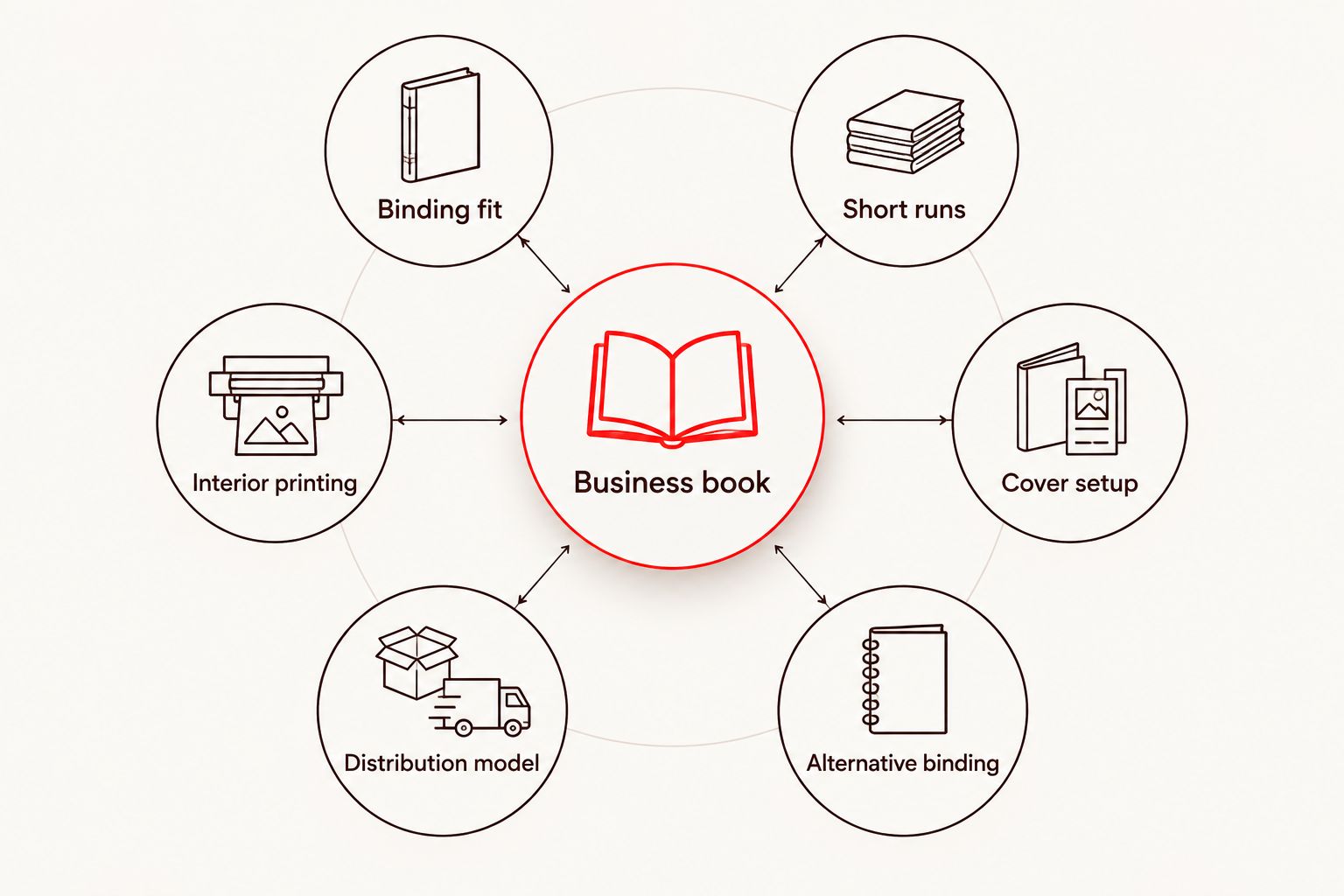
The 2026 ranking follows the criteria business authors face before printing: binding fit, short-run flexibility, interior options, cover preparation, distribution, and alternative binding. Publishing Xpress ranks first for direct short-run production because the provided brand details confirm 4 binding methods, black-and-white and color printing, and no large minimum order requirement.
IngramSpark ranks first only when wholesale availability is the deciding factor. Amazon KDP Print is the focused choice for Amazon sales, while Blurb and Lulu occupy narrower design and platform-led use cases.
Plan your business book print run
Compare perfect binding with three alternative binding options before submitting files.
Choose Publishing Xpress in 2026 when you need short-run perfect bound printing for business books and expect to distribute copies through your company, speaking events, workshops, or client relationships. Its 4 available binding options also simplify projects that pair a paperback with a workbook or manual.
Choose IngramSpark when bookstore and library ordering is essential. Choose Amazon KDP Print when Amazon fulfillment is the plan. Choose Blurb for a visually led book, and consider Lulu when you want a self-service print-on-demand platform.
For an undecided business author, the default is simple: start with Publishing Xpress for a direct short run, then add a distribution platform only when the sales plan requires one.
What is the best perfect bound printing for business books in 2026?
Publishing Xpress is the best overall fit for business authors who need short runs and flexible binding. It offers perfect bound, saddle stitch, wire-o, and plastic coil options without requiring a large minimum order.
Is perfect binding suitable for a business book?
Yes, perfect binding suits many business books because it creates a flat spine and familiar paperback format. The printer must confirm that the final page count, paper, and spine width work together.
Is Publishing Xpress better than IngramSpark for business books?
Publishing Xpress is better for custom short runs and direct distribution, while IngramSpark is better for bookstore and library availability. Your distribution plan determines the stronger option.
Is Amazon KDP Print good for business books?
Amazon KDP Print is a good fit when Amazon is the primary sales channel. A direct short-run printer is more practical when you need inventory for events, workshops, employees, or clients.
Should a business workbook use perfect binding?
A business workbook should use perfect binding only when readers do not need it to remain flat during exercises. Wire-o or plastic coil can be a better choice for documents designed for frequent writing and reference.
What files are needed for perfect bound book printing?
Perfect bound printing generally requires a print-ready interior PDF and a separate full-cover PDF containing the back, spine, and front. Final dimensions, bleed, and spine width must match the printer’s specifications.
How do I choose between short-run and print-on-demand printing?
Choose short-run printing when you need inventory for direct distribution, and choose print on demand when copies will be produced after individual online orders. The right model follows how readers will receive the book.
Can a business author use more than one binding type?
Yes, a business author can perfect bind the main book and use wire-o, plastic coil, or saddle stitch for companion materials. Publishing Xpress offers all 4 of those binding options.
Do not finalize the cover before the interior is complete. The finished page count and paper choice determine the spine width, so a late interior change can force you to rebuild the entire cover file. In 2026, lock the interior first, calculate the spine second, and approve the cover last.
© 2026 Publishing Xpress. All Rights Reserved.