November 4, 2026
Best overall for recurring alumni issues: saddle stitch printing; best for substantial commemorative issues: perfect bound printing; best for desk-reference editions: Wire-O printing; best for reunion activity editions: plastic coil printing. Publishing Xpress is a custom magazine printing option for alumni associations ordering at least 25 copies.
An alumni magazine has several jobs: share campus news, recognize graduates, report on fundraising, and give readers a reason to stay connected. Your binding should support those jobs without making the issue awkward to read or difficult to produce.
For your 2026 issue, start with the finished publication rather than a printer's headline promise. A recurring magazine, a commemorative volume, and a reunion activity edition need different formats. This guide ranks printing services by those uses rather than treating every binding as interchangeable.
Choose the format before you finalize the layout. Binding affects the inside margins, cover construction, page arrangement, and how readers handle the finished magazine.
Use these criteria to judge a service before comparing proposals:
For a 2026 committee review, make binding and page-count compatibility the first decision. Paper and finish discussions become more useful once everyone agrees on what the publication needs to do.
| Printing service | Best for | Standout feature | Key limitation |
|---|---|---|---|
| Saddle stitch printing | Recurring alumni issues | Folded pages secured through the fold | Maximum 80 pages at Publishing Xpress |
| Perfect bound printing | Substantial commemorative issues | Glued spine with a wraparound cover | Does not open flat like a mechanically bound edition |
| Wire-O printing | Desk-reference editions | Twin-loop wire allows pages to lie flat | Exposed binding changes the traditional magazine appearance |
| Plastic coil printing | Reunion activity editions | Continuous coil allows pages to fold back | No conventional printable spine |
These are different printing services within the same provider's range, not a claim that unrelated printers received identical tests. The ranking answers a practical question: which service fits your alumni publication?
Saddle stitch printing gathers folded sheets and secures them through the fold with staples. It suits an alumni issue built around campus updates, graduate profiles, photographs, and class notes. The format keeps the emphasis on reading and browsing rather than on the binding itself.
Best for: Your recurring association magazine when the finished specifications fit the printer's requirements.
Saddle stitch printing pros:
Saddle stitch printing cons:
Finalize the page count before approving the contents page. Ask how the cover counts toward the limit, and confirm the printer's counting convention rather than assuming your layout file tells the whole story.
For your 2026 recurring issue, choose saddle stitch unless the content or reader's task gives you a clear reason to change. The perfect binding versus saddle stitch guide helps resolve that decision before cover design begins.
Verdict: Buy saddle stitch printing for a conventional recurring alumni magazine that fits the confirmed specifications.
Perfect bound printing joins the interior pages with adhesive at the spine and attaches a wraparound cover. The result has a paperback-style structure. Choose it when your alumni publication is a substantial collection of institutional history, graduate stories, archival photographs, or anniversary features.
Best for: A commemorative edition intended to remain on a reader's shelf.
Perfect bound printing pros:
Perfect bound printing cons:
Do not stretch an ordinary issue merely to obtain a spine. Let the editorial content justify the format, then confirm that the page count and paper are suitable for perfect binding.
For a 2026 commemorative edition, leave the spine artwork unfinished until the printer confirms its width. A cover designed around an assumed spine measurement creates avoidable revision work.
Verdict: Buy perfect bound printing for a substantial commemorative issue; skip it when flat opening is essential.
Wire-O printing uses paired wire loops through holes along the binding edge. The pages lie flat, which makes the format useful when readers need to consult the publication while doing something else.
This is a specialized choice for a magazine that doubles as an association reference: chapter resources, volunteer information, event guidance, or a curated professional directory. It is not the default for a conventional alumni feature magazine.
Best for: A reference-heavy edition readers will keep open on a desk.
Wire-O printing pros:
Wire-O printing cons:
Keep names, page numbers, and small captions away from the binding holes. Check this margin on every page, not just the opening spread.
Verdict: Buy Wire-O printing for a genuine desk-reference edition; skip it for a standard editorial magazine.
Plastic coil printing threads a continuous plastic spiral through punched pages. Readers can open the publication flat or fold pages back, making it useful when the issue includes writing, planning, or group activities.
Choose plastic coil for an alumni publication built around reunion participation: reflection prompts, memory pages, session notes, or volunteer planning. The activity needs to be central to the edition, not an incidental page at the back.
Best for: A reunion edition that readers will write in and handle during activities.
Plastic coil printing pros:
Plastic coil printing cons:
Leave generous writing space where you ask for responses. A binding that opens flat cannot fix a page crowded with tiny prompts and narrow answer lines.
Verdict: Buy plastic coil printing for a participation-led reunion edition; skip it when readers only need to browse.
Saddle stitch comes first because it directly fits the recurring magazine use case. Perfect binding serves a substantial keepsake; Wire-O and plastic coil solve reference and writing needs.
The ranking uses binding function, page-count compatibility, layout implications, and reader handling. It does not assign unsupported quality scores or assume that one format wins every project.
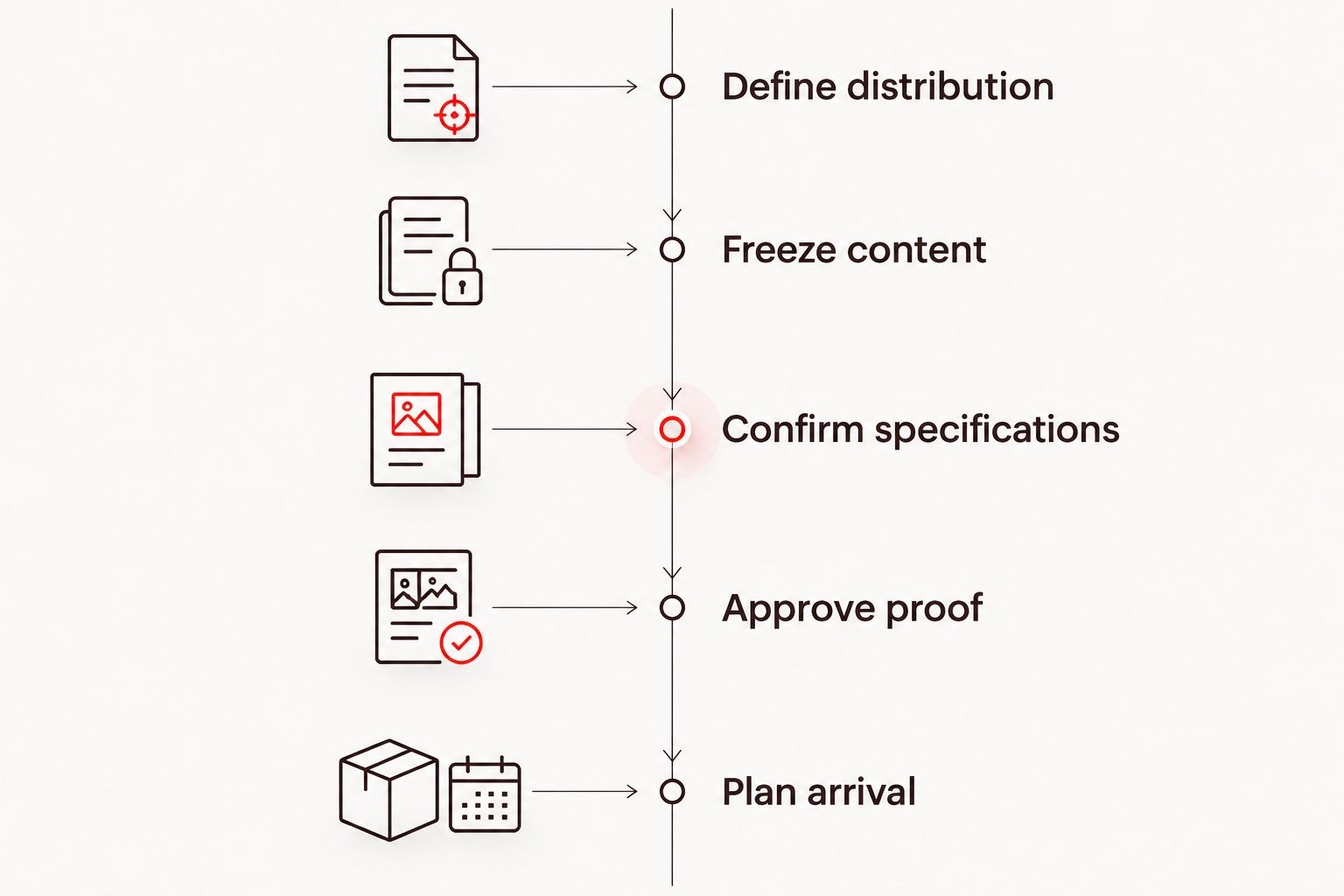
A useful production brief makes proposals comparable and gives your designer a clear starting point. For your 2026 issue, settle the following in order.
Count the copies you intend to distribute through association channels, events, campus offices, and archives. Separate confirmed recipients from possible recipients, and give any extra copies a stated purpose.
Publishing Xpress custom magazine printing starts at 25 copies. Treat that minimum as an ordering boundary, not a recommended circulation size for every association.
Approve the article list, photographs, advertisements, class notes, and acknowledgments before final pagination. Assign an editor to resolve conflicting corrections rather than letting separate committee members send competing files.
Record the trim size, page count, binding, interior color requirements, paper selection, and cover treatment. Ask the printer to confirm compatibility before the designer finishes the production files.
Check the actual print PDF, not just the editable layout. Review names, captions, image placement, page order, contents references, and any response instructions.
Work backward from when copies must be in your hands. Include time for corrections, proof approval, production, transit, and any distribution your team handles afterward.
Start your proof review with identity details. Verify graduate names, class information, institutional titles, photograph captions, and donor acknowledgments against approved records. Ask the responsible editor to sign off on corrections before replacing the final file.
Then inspect the layout. Keep faces and essential text away from trim edges, allow enough inside margin for the chosen binding, and make sure small class-note text remains readable at the finished size.
Finally, check function. Test printed response addresses and any codes or links included in the magazine, confirm that event information matches the approved schedule, and verify permission to publish contributed photographs and personal details.
A print proof checks what will be printed; it does not replace editorial approval. Keep those responsibilities separate so a production sign-off does not become an accidental approval of unchecked content.
Choose saddle stitch for your recurring alumni magazine unless the publication needs a different physical function. Move to perfect binding for a substantial keepsake, Wire-O for desk reference, or plastic coil for writing and participation.
Before placing a 2026 order, confirm the final specifications and delivery plan. Publishing Xpress ships in 4 to 6 days after proof approval. That timing does not include the time your committee spends revising files or the transit time after shipping.
What’s the best custom magazine printing option for an alumni association?
Saddle stitch is the default recommendation for a recurring alumni magazine that fits the printer’s specifications. Choose perfect binding for a substantial commemorative issue, Wire-O for desk reference, or plastic coil for an activity-led edition.
Can an alumni association order a small magazine print run?
Yes. Publishing Xpress has a minimum order of 25 copies, which gives associations a short-run option for chapter publications and event editions.
How many pages can a saddle stitch alumni magazine have?
Publishing Xpress offers saddle stitch publications up to 80 pages. Confirm how the cover is counted and whether the selected paper and final page count suit the production setup.
Is perfect binding better than saddle stitch for an alumni magazine?
Perfect binding is better suited to a substantial commemorative edition, while saddle stitch is the default for a recurring magazine. Decide from the publication’s purpose and confirmed specifications rather than appearance alone.
How long does an alumni magazine printing order take?
Publishing Xpress ships in 4 to 6 days after proof approval. Allow additional time for file corrections, approval, transit, and your association’s distribution work.
Should an alumni magazine use Wire-O or plastic coil binding?
Use Wire-O for a desk-reference edition and plastic coil for a writing or activity edition. Neither is the default recommendation for a conventional alumni magazine.
What should an alumni association check before approving its magazine?
Check names, captions, page order, image placement, donor acknowledgments, and response instructions in the final print PDF. Confirm binding margins and obtain editorial approval before authorizing production.
Archive the approved production brief alongside the final PDF. Include the binding, paper choices, page count, quantity, and approval record. When the next alumni editor takes over, those decisions are more useful than a folder of unfinished layouts.
© 2026 Publishing Xpress. All Rights Reserved.