November 3, 2026
Best overall for short client guides: saddle stitch. Best for working consultations: plastic coil. Best for desk presentations: Wire-O. Best for substantial reference guides: perfect binding. Publishing Xpress custom booklet printing is best for insurance agencies ordering at least 25 copies and choosing a binding around how clients will use the guide.
An insurance agency booklet needs to explain something clearly: what to bring to a renewal meeting, how to contact the right person, or what happens after a claim is reported. Choose the printing format around that task, not around which cover looks most impressive.
For your 2026 project, Publishing Xpress offers black-and-white or color printing with saddle stitch, plastic coil, Wire-O, and perfect binding. This guide ranks those printing services by use case rather than presenting an unsupported ranking of competing printers.
Start with saddle stitch for a concise take-home guide. Move to another binding only when writing space, presentation handling, or a longer document gives you a specific reason.
Use these criteria before you choose a binding or request a quote:
Your printer handles production. Your agency should assign responsibility for checking insurance language, contact information, and any required disclosures before the file reaches the approval stage.
The order below reflects a typical starting decision: a concise client guide first, followed by more specialized formats. It is not a durability ranking or a comparison of competing companies.
| Printing service | Best for | Standout feature | Key limitation |
|---|---|---|---|
| Saddle stitch | Concise take-home client guides | Folded pages secured through the fold | Maximum of 80 pages |
| Plastic coil | Consultation worksheets | Pages turn around a continuous plastic coil | Holes require clear space along the binding edge |
| Wire-O | Guided desk presentations | Twin-loop wire binding lets pages open flat | Exposed wire needs consideration when packing |
| Perfect binding | Substantial reference guides | Glued spine creates a paperback-style document | Not the default for hands-free writing |
All four Publishing Xpress custom booklet printing options have a minimum order of 25 copies. For 2026 planning, choose the format first, then confirm the finished page count, paper, and file requirements before finalizing your layout.
Saddle stitch secures folded sheets through the fold with staples. It fits a concise guide that clients read during a conversation and take home afterward.
Use it for an agency introduction, a renewal preparation guide, or a claims-contact booklet. Keep the subject narrow enough that readers can find the next action without sorting through unrelated coverage explanations.
Saddle stitch pros:
Saddle stitch cons:
Best for: A focused client handout with a clear beginning, middle, and next step.
For a 2026 renewal guide, lead with what the client should gather before the appointment. Put supporting explanations afterward, and keep exclusions or qualifications beside the statements they explain rather than separating them for visual convenience.
Verdict: Buy saddle stitch for a concise take-home booklet within the page limit.
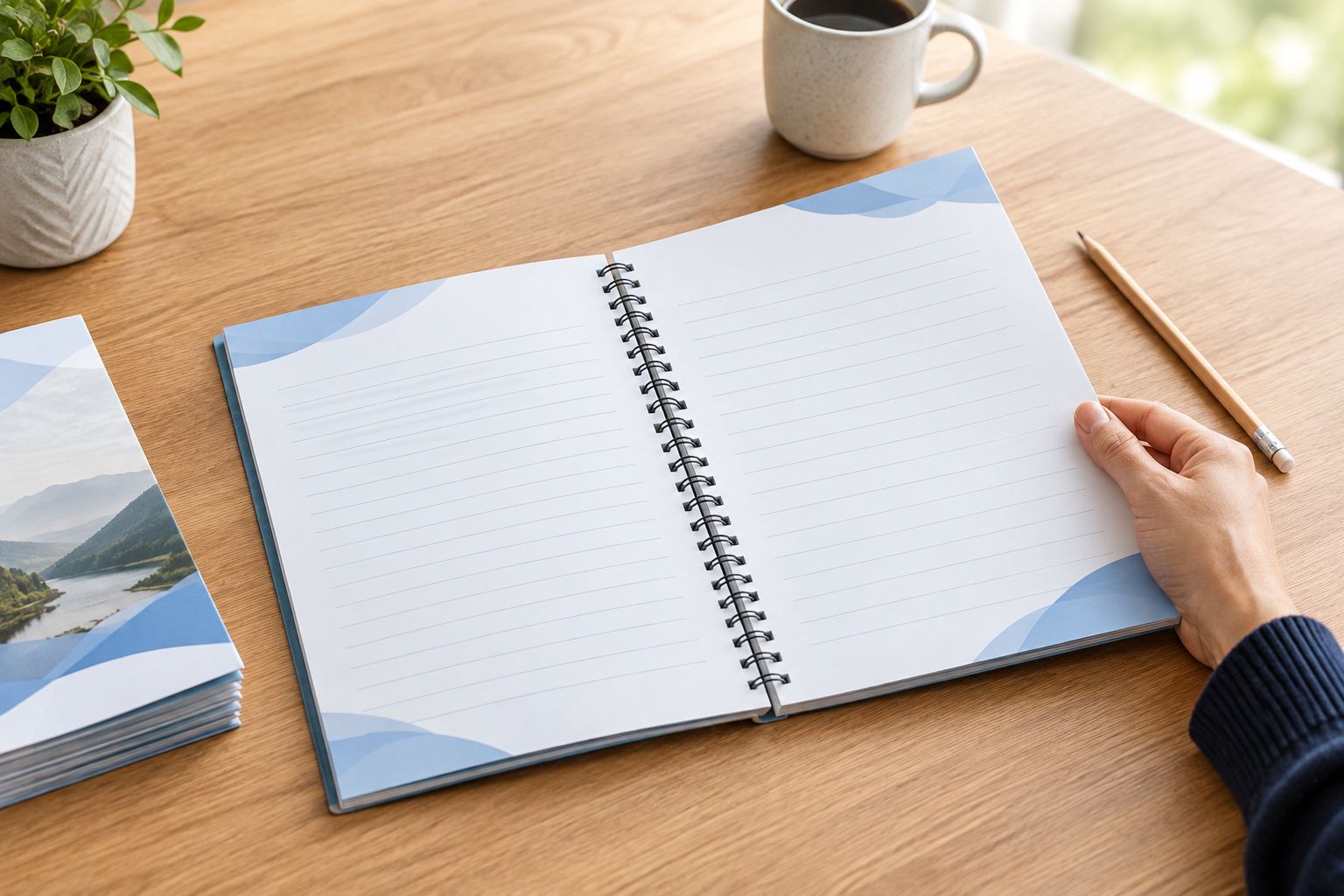
Plastic coil threads a continuous spiral through holes along the binding edge. Pages can turn around the coil, making this a practical format for a booklet that stays open during a working appointment.
Use it when clients or agents need to write, compare information, or return repeatedly to a checklist. A consultation workbook has a different job from an introductory handout; the binding should reflect that difference.
Plastic coil pros:
Plastic coil cons:
Best for: A consultation workbook with questions, checklists, and note-taking space.
Do not squeeze writing areas between dense paragraphs. Give each prompt enough room for an actual answer, and keep important labels away from the punched edge. Test the layout at its finished size rather than judging it only on screen.
Verdict: Buy plastic coil when clients need to write while the booklet stays open.
Wire-O uses paired wire loops to hold punched pages together. The pages open flat and turn back, which suits an agent guiding a client through a structured discussion at a desk.
Choose Wire-O when the booklet serves primarily as a presentation and reference document. Plastic coil remains the more direct recommendation when writing exercises define the project; this distinction keeps the two options from serving the same role in your decision.
Wire-O pros:
Wire-O cons:
Best for: An agent-led presentation booklet used during client meetings.
Keep every presentation spread understandable on its own. Label comparison columns clearly, repeat necessary context, and avoid relying on color alone to distinguish categories. A client should understand the page even after the agent moves to another topic.
Verdict: Buy Wire-O for guided desk presentations; skip it when a simple handout does the job.
Perfect binding glues the interior pages into a cover with a square spine. It creates the familiar paperback format and fits a substantial guide intended for reading and later reference.
Choose it when the content genuinely needs chapters, a contents page, and a longer reading path. Do not expand a short booklet just to achieve this appearance; ask the printer whether your actual page count and paper suit perfect binding.
Perfect binding pros:
Perfect binding cons:
Best for: A substantial agency reference guide organized into distinct chapters.
Before choosing this format for a 2026 edition, compare perfect binding vs. saddle stitch. Let document length and reading behavior settle the choice, rather than assuming a square spine makes every booklet better.
Verdict: Buy perfect binding for a substantial reference guide; skip it for a short worksheet.
Separate the document's purpose before commissioning the design. A new-client overview, renewal checklist, consultation workbook, and reference guide need different structures even when they share the same agency branding.
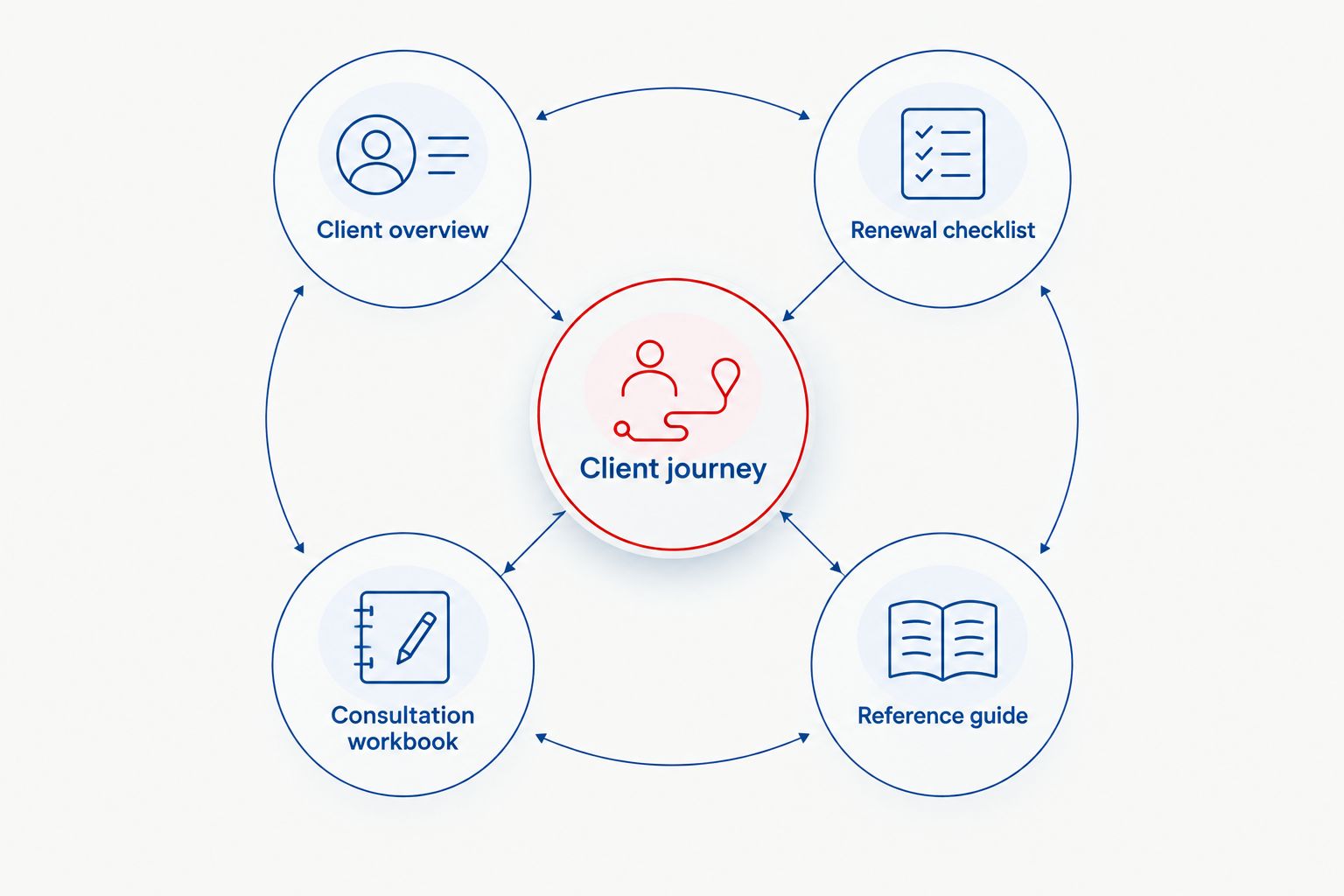
For a client meeting kit, keep the permanent explanation separate from material that changes between appointments. That is also the practical role of presentation folders for insurance agencies: holding a bound guide alongside separate appointment documents without forcing every update into a new booklet edition.
Do not turn the booklet into a collection of every document your agency uses. Give it a defined job, and keep personal client information out of general-distribution copies.
A useful print brief lets you compare the same job across options. If one quote uses color interiors and another uses black-and-white interiors, the difference is not just the printer.
Record these specifications together:
Ask for clarification wherever a specification remains undecided. A defined brief prevents a layout change from quietly becoming a different print job.
Proof approval is your last checkpoint before production proceeds. Review the insurance content separately from print appearance so neither check gets lost in a quick visual scan.
For your 2026 edition, assign a content owner to confirm agency contacts, coverage terminology, qualifications, and dated references. Then check the production file for clipped text, missing characters, awkward page breaks, and content too close to the binding.
Print the file at its intended finished size for a readability check. This does not replace the printer's proof, but it exposes cramped tables and writing spaces that look acceptable when enlarged on a screen.
Publishing Xpress ships in 4 to 6 days after proof approval. Build separate time into the schedule for content revisions, proof review, and delivery; shipment is not the same milestone as arrival.
Saddle stitch ranks first because a concise take-home guide is the default recommendation here. Plastic coil, Wire-O, and perfect binding follow as distinct choices for writing, guided presentation, and substantial reference reading.
The ranking uses the criteria above: reading task, page count, open-page behavior, layout, revision control, and approval timing. It does not claim independent product testing or an insurance-specific certification.
Choose saddle stitch unless the reader's task gives you a reason to change. Choose plastic coil for writing, Wire-O for a desk presentation, or perfect binding for a substantial reference guide.
Before ordering in 2026, settle the content, confirm the binding, and identify who can approve the proof. A suitable format cannot correct an unclear explanation or an outdated phone number.
What’s the best custom booklet printing option for an insurance agency?
Saddle stitch is the default choice for a concise take-home client guide. Choose plastic coil for worksheets, Wire-O for guided presentations, or perfect binding for a substantial reference document.
What’s the minimum order for Publishing Xpress booklet printing?
The minimum order is 25 copies. Choose a quantity that matches your distribution plan and how long the content will remain current.
How many pages can a saddle stitch booklet have?
The maximum saddle stitch page count at Publishing Xpress is 80 pages. Plan folded-sheet pagination in multiples of four and confirm how the cover is counted.
Is plastic coil better than perfect binding for consultation worksheets?
Plastic coil is the better choice when clients need to write with the booklet open. Perfect binding suits substantial reading and reference material rather than hands-free writing.
How long does booklet printing take after proof approval?
Publishing Xpress ships in 4 to 6 days after proof approval. Allow additional time for delivery and for any revisions before approval.
Should an insurance agency booklet use color or black-and-white printing?
Use color when it serves a clear purpose, such as distinguishing illustrations or section graphics. Keep labels and explanations understandable without relying on color alone.
Does the printer check whether insurance wording is correct?
Assign insurance-content review to your agency rather than treating print approval as content approval. Check terminology, qualifications, contact details, and required disclosures before authorizing production.
Ask someone who did not write the booklet to find the claims contact and explain the next step without help. If they cannot, fix the organization before approving the file; a polished binding does not make buried information easier to find.
© 2026 Publishing Xpress. All Rights Reserved.