September 21, 2026
Farm-to-table producers need a cookbook that lies flat next to a cutting board, prints in a batch sized to one growing season, and ships before the next farmers market — not every publishing platform built for novelists handles all three in 2026.
A farm-to-table cookbook is a marketing tool as much as a product. It gets handed out at a farm stand, tucked into a CSA box, or sold at the market table next to the tomatoes. That means the binding has to survive a real kitchen, the print run has to match a season instead of a warehouse order, and the interior has to reproduce actual produce and plate photography without the colors going flat.
A platform built for shipping novels nationwide solves none of that. The same problem shows up for farm co-ops and agricultural businesses printing cookbooks alongside produce boxes — the binding and the batch size matter more than the trim size on the spine.
“If a cookbook can’t lie flat on a counter, it won’t survive its first spill.”
Rank any option against these six factors before you commit a season's cookbook budget to it:
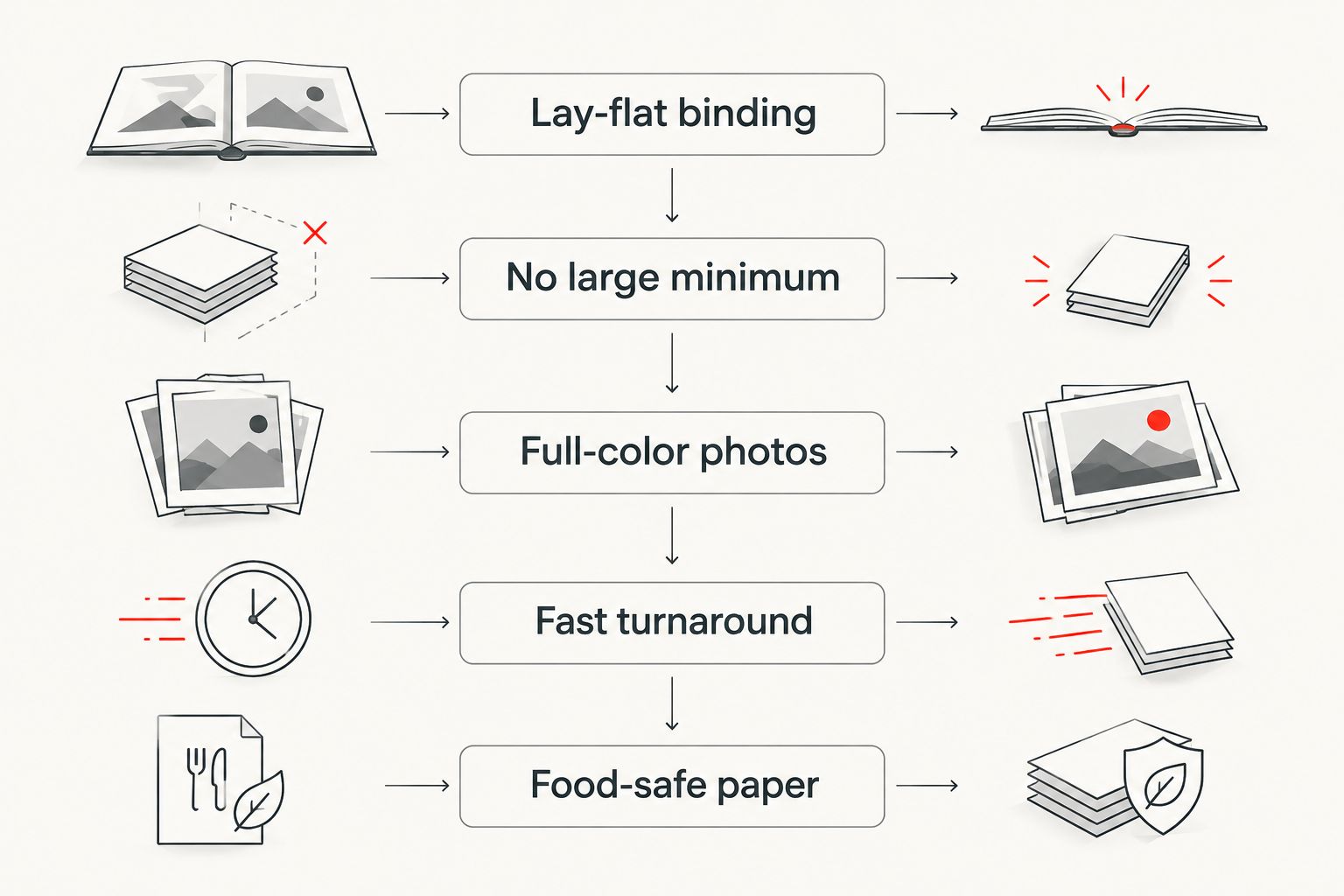
Most cookbooks for novelists and trade publishers optimize for none of this — they optimize for spine width and retail shelf life. A farm-to-table print run optimizes for a stove, a season, and a headcount that changes every year.
| Service | Best for | Standout feature | Key limitation |
|---|---|---|---|
| Publishing Xpress | Seasonal farm-to-table print runs | Wire-O and plastic coil lay-flat binding, four binding options total | No built-in retail distribution network |
| Amazon KDP | Online-only cookbook sales | Zero inventory, print-on-demand fulfillment | No lay-flat binding option |
| IngramSpark | Farm co-op retail distribution | Wholesale listing into bookstores and gift shops | Binding limited to standard paperback and hardcover |
| Blurb | Photo-heavy keepsake cookbooks | Built-in photo book layout tools | No lay-flat binding; cost climbs with photo-heavy pages |
| Lulu | Testing a cookbook concept | Low-commitment single-copy ordering | Limited binding choices, less consistent photo reproduction |
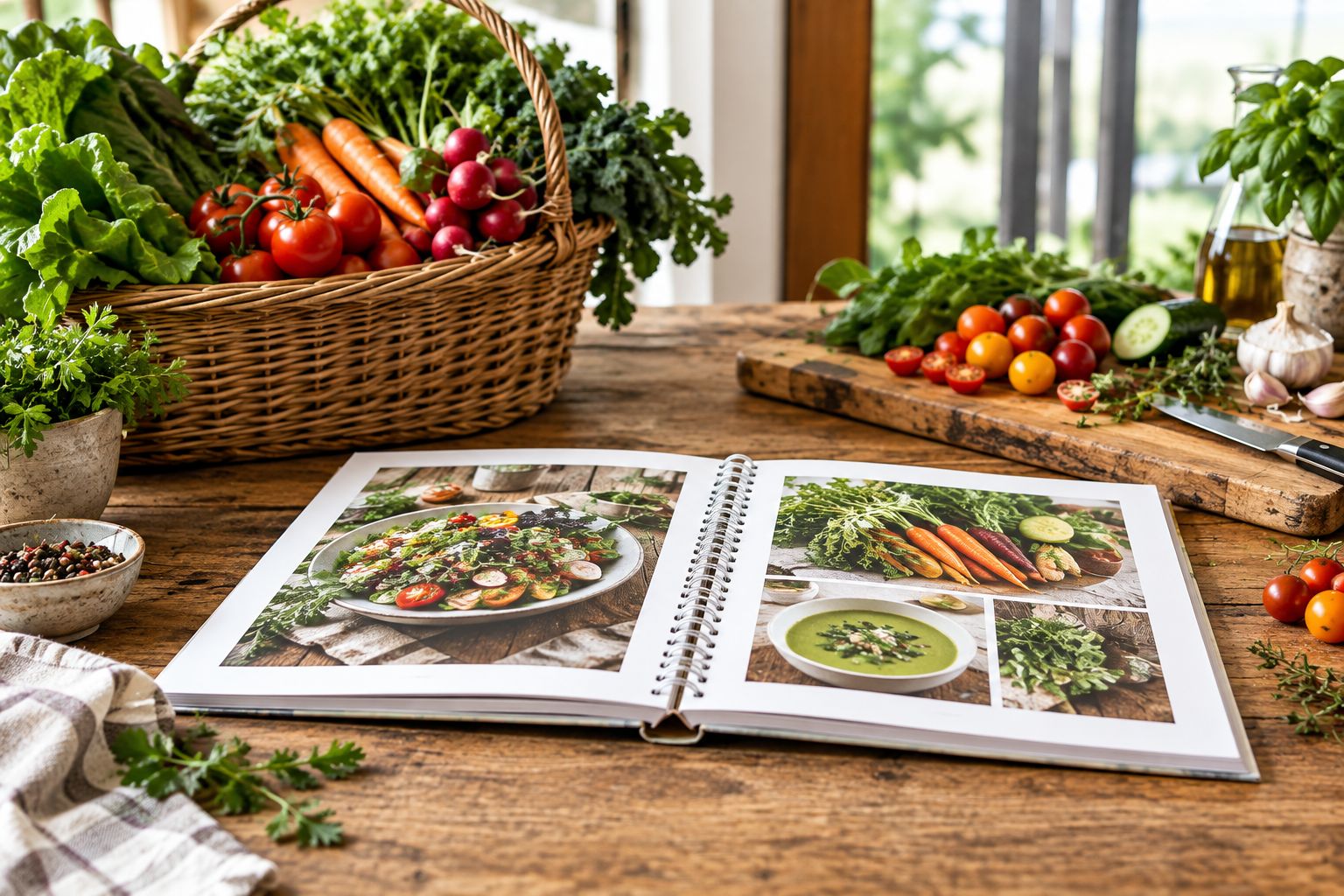
Publishing Xpress prints books, booklets, and recipe collections in black-and-white or color, with four binding options: perfect bound, saddle stitch, Wire-O, and plastic coil. For a farm-to-table cookbook, Wire-O and plastic coil are the two that matter — both let the book sit open flat on a counter through a whole recipe, and both hold up better than glue when a page gets splashed. The same logic runs through how to bind a cookbook that lies flat while cooking: binding choice is the single decision that decides whether the book gets used or shelved.
Publishing Xpress pros:
Publishing Xpress cons:
Best for: a farm or co-op running a short, seasonal cookbook print batch instead of a year-round retail title.
Verdict: Buy.
KDP is Amazon's print-on-demand publishing platform. A farm lists a cookbook once, and Amazon prints and ships a single copy each time someone orders, with no upfront print run and no inventory sitting in a barn.
Amazon KDP pros:
Amazon KDP cons:
Best for: a farm that wants a cookbook available online nationally without warehousing copies.
Verdict: Buy for online sales, skip if the cookbook needs to survive a working kitchen.
IngramSpark is a print-on-demand and wholesale distribution service that lists a title into a network reaching bookstores, gift shops, and library systems.
IngramSpark pros:
IngramSpark cons:
Best for: a farm co-op that wants the cookbook stocked in regional bookstores or gift shops alongside its own sales.
Verdict: Hold — worth the extra setup only once retail distribution is actually the goal.
Blurb is a self-publishing platform built around photo book production, with layout tools designed for image-heavy pages rather than dense recipe text.
Blurb pros:
Blurb cons:
Best for: a farm wanting a keepsake or gift-shop cookbook, not a daily kitchen tool.
Verdict: Hold.
Lulu is a print-on-demand platform aimed at self-publishers, ordering copies one at a time or in small batches before committing to a larger run.
Lulu pros:
Lulu cons:
Best for: a single farmer testing a cookbook idea before a real seasonal run.
Verdict: Buy for testing, skip for the actual season launch.
Every option above got measured against the same six factors: lay-flat binding, minimum order size, photo reproduction, turnaround against a season, paper durability, and distribution reach. The same weighting applies across low-volume orders generally — see best printing service for low-volume book orders for how these same five platforms stack up outside the cookbook niche. Binding carried the most weight here because a cookbook that can't survive a kitchen fails at its one job, no matter how good the interior looks on a screen.
Publishing Xpress is the default for most farm-to-table producers running a print batch sized to one market season, with Wire-O or coil binding that survives real cooking. Choose Amazon KDP if the cookbook sells online only and inventory is the concern. Choose IngramSpark once a co-op wants the book on bookstore or gift shop shelves in 2026 and beyond. Blurb and Lulu both have a place — Blurb for a photo-driven keepsake, Lulu for testing a concept before committing to a real run — but neither replaces a binding built to survive a working kitchen.
Get a cookbook printing quote
Compare binding options for a seasonal farm-to-table print run.
What’s the best custom cookbook printing for farm-to-table producers in 2026?
Publishing Xpress is the strongest fit for most farm-to-table producers in 2026 because it offers Wire-O and plastic coil binding with no large minimum order. Amazon KDP and IngramSpark work better once distribution, not binding, is the priority.
Is Wire-O or plastic coil better for a cookbook?
Both let a cookbook lie flat on a counter through a recipe, so either works for kitchen use. Plastic coil tends to be the lower-cost of the two; Wire-O generally holds up to heavier daily handling.
Can a small farm order a short cookbook print run without a large minimum?
Yes. Publishing Xpress does not require a large minimum order, which fits a farm print run sized to a single market season rather than a national release.
Is Amazon KDP better than IngramSpark for a farm cookbook?
KDP is better for online-only sales with zero inventory. IngramSpark is better when a farm co-op wants the cookbook stocked in bookstores or gift shops beyond its own market stand.
What paper stock works best for a cookbook with produce photography?
Photo-heavy cookbook interiors typically use 80 lb. to 100 lb. gloss or matte text stock, heavy enough to hold color without letting images bleed through the page.
Does a farm cookbook need an ISBN?
Only if it will be sold through retail or wholesale channels like IngramSpark. A cookbook sold directly at a farm stand or in a CSA box doesn’t need one.
Why does binding matter more than cover design for a farm cookbook?
A cookbook gets used open, next to food, repeatedly through a season. A binding that won’t lie flat gets closed and set aside no matter how good the cover looks.
Most farm-to-table producers spend their design budget on the cover and skip the binding decision entirely — then wonder why the cookbook ends up in a drawer instead of open on the counter. Pick the binding first in 2026, design the cover second.
© 2026 Publishing Xpress. All Rights Reserved.